
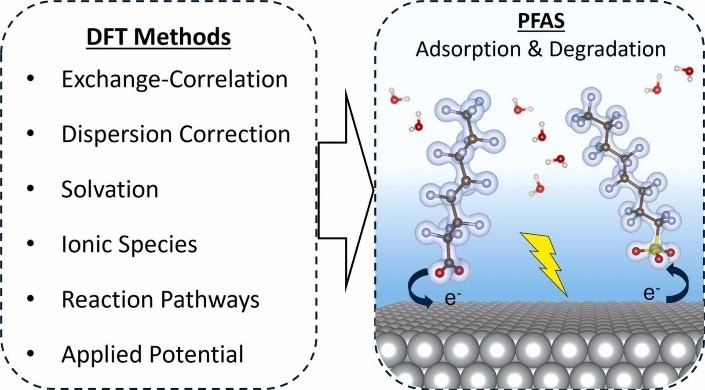
A recent scientific review highlights how molecular simulations can guide the capture and degradation of per- and polyfluoroalkyl substances (PFAS). These persistent “forever chemicals” pose serious risks to the environment and human health.
Published in the Journal of Environmental Chemical Engineering, the article “Ab-initio Computational Methods for PFAS Adsorption and Degradation: A Critical Review” by Mohamed S. Mohamed, Brian P. Chaplin, and Ahmed A. Abokifa examines how atomic-scale modeling reveals interactions between PFAS molecules and various materials. It also examines how catalytic surfaces can accelerate PFAS breakdown.
The review focuses on computational techniques such as density functional theory (DFT) and ab initio molecular dynamics (AIMD). These methods show how PFAS adsorb and react on surfaces. These insights can guide the design of improved remediation strategies.
The authors report that PFAS adsorption depends on the type of interaction. The reactive “head group” drives chemical bonding, called chemisorption. The fluorinated chain controls weaker physical interactions, known as physisorption. Surface features, such as exposed crystal facets, defects, and preadsorbed species, also influence PFAS binding and degradation.
Catalytic and electrochemical surfaces can alter reaction pathways, which affects the speed of PFAS breakdown. The review also discusses how modeling choices—such as exchange-correlation functionals, dispersion corrections, and solvation models—affect simulation accuracy and recommend the appropriate level of theory for various applications.
Looking ahead, the authors call for more realistic simulations. They suggest including complex surface features and accurately representing PFAS charge states. They also recommend electrochemical models run under constant potential to better reflect real-world conditions. Additionally, machine learning trained on high-quality quantum data could speed the discovery of new PFAS degradation pathways.
By highlighting methodological gaps and offering validated computational protocols, the review helps identify the most effective simulation approaches. These insights can guide future studies and help develop practical strategies for mitigating PFAS contamination.