
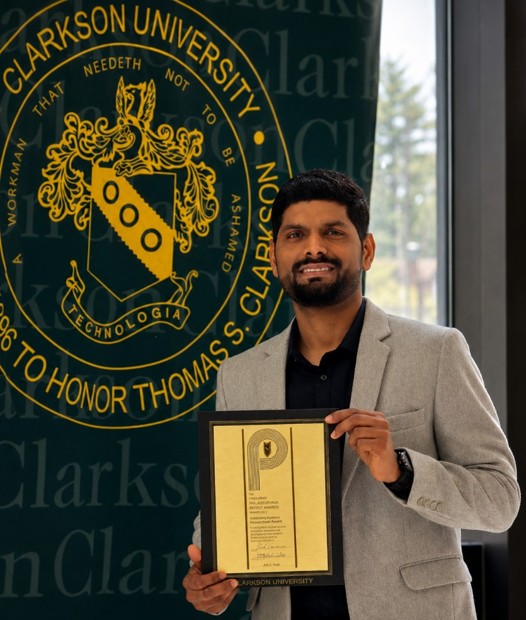
Raised in the town of Chiniot, Pakistan, Sheraz Bashir earned his bachelor’s degree from the University of the Punjab and later a master’s degree in Chemical Engineering from the King Fahd University of Petroleum and Minerals in Saudi Arabia. Over several years working on industrial wastewater treatment at the University of Hafr Al Batin in Saudi Arabia, Bashir discovered a passion for water research that ultimately led him to Clarkson University in New York, where he is currently pursuing a Ph.D.
Bashir’s doctoral research centers around developing membrane-based electrochemical separation technologies that recover valuable resources from unconventional water sources, including reverse osmosis (RO) concentrate or brines, geothermal brine, and wastewater. “The goal of my work is to extract valuable resources from these challenging waste streams, while advancing water sustainability and circular economy solutions,” said Bashir.
Working on the NAWI project in the Green Electrochemical Research (GreenER) Lab under faculty mentor Dr. Taeyoung Kim “has been one of the most transformative experiences of my research journey in the U.S.,” said Bashir.
Bashir’s research group worked to address sustainability challenges under NAWI Project 6.21. As part of one project study, he and his collaborators studied how water chemistry influences electrochemical precipitation and demonstrated 93% removal of scaling ions from brackish groundwater RO concentrate under electrochemically induced alkaline conditions, even in the presence of antiscalants. Building on this, he used a proof-of-concept electrochemical hydrogen-looping strategy to drive pH-mediated mineral precipitation and substantially lower the energy required to selectively remove calcium and recover valuable magnesium. Combined, the studies demonstrated a sustainable way forward for electrochemical brine valorization.
“Beyond providing funding support, NAWI has given me the platform to work with an exceptional multidisciplinary team including faculty and grad students spanning Clarkson University (Dr. Taeyoung Kim and Dr. Yang Yang), Washington University in St. Louis (Dr. Young-Shin Jun), Arizona State University (Dr. Tiezheng Tong), Colorado State University (Dr. David Quiroz), Argonne National Lab (Dr. Sang Soo Lee), and industry partner OLI Systems (Leslie Miller). This environment has strengthened my technical expertise while also shaping how I think about collaborative, system-level solutions addressing critical water challenges.”
With Project 6.21 complete, Bashir is exploring the fundamental mechanisms governing ion transport across selective and non-selective membranes during the electrochemical precipitation of RO concentrate. Building on these findings, he will be expanding his research expertise into electrochemical nutrient recovery from wastewater. After graduation, Bashir aims to pursue postdoctoral research focused on sustainable water treatment and resource recovery, continuing to advance technologies that make water treatment more sustainable and economically viable.
Beyond his research, Bashir has taken on leadership roles that reflect his commitment to mentoring and professional service, including his current post as the President of the Electrochemical Society (ECS), Clarkson Student Chapter. He also serves on committees as part of the Association of Environmental Engineering and Science Professors (AEESP). “Mentorship and collaborative research have been key milestones in my journey, shaping both my growth as a researcher and my commitment to supporting and mentoring others in STEM,” said Bashir. “One of my most rewarding experiences has been seeing my mentees advance in their careers, with many progressing to competitive master’s and Ph.D. programs or impactful industry roles.”
Outside the lab, Bashir enjoys daily workouts, playing volleyball, and exploring New York’s North Country.