• Skip to primary navigation
  • Skip to main content
  • Skip to primary sidebar
  • Skip to footer
National Alliance for Water Innovation (NAWI)

National Alliance for Water Innovation (NAWI)

Innovating for a water and energy secure future for the United States

  • About
    • Who We Are
    • Our Team
    • Our Partners
    • Contact Us
  • Research & Projects
    • Projects
    • Process Innovation and Intensification
    • Materials and Manufacturing
    • Data Modeling and Analysis
    • Devices
    • Treatment Trains
    • Regional Water Systems
  • Publications & Data
    • Academic Publications
    • Roadmap Report Series
    • WaterTAP | Tool
    • Acknowledgments, Credit Lines, and Disclaimers
  • Join Us
    • Consortium Documents
    • NAWI Network FAQs
  • Funding
    • Opportunities
    • Resources
    • Acknowledgments, Credit Lines, and Disclaimers
    • Funding FAQs
  • News & Stories
    • News
    • Blogs and Stories
    • Multimedia
    • Media
  • Join

Water

NAWI and the NextGen Program are seeking participants for the 2026 – 2027 mentorship program (September 2026 – February 2027). Applications are due on August 31, 2026 – apply today!

Apply to be a Mentee 

Apply to be a Mentor

About the Program

The NAWI NextGen Mentorship Program leverages the NAWI Network’s experiences and expertise to:

  • Foster meaningful connections across career stages and disciplines
  • Empower young professionals to learn from mentors and peers
  • Build relationships that support professional and personal growth

Mentor-mentee groups pair mentors, who are typically further along in their education or career, with at least one early-career mentee. We anticipate offering several types of mentorship programs this year, including groups focused on PhD Advice, Careers in Industry, Careers in Academia, and Careers in National Labs. Availability will depend on interest.

The program consists of 6 mentor-mentee meetings scheduled between September 2026 and February 2027. There are opportunities for limited participation if you are unable to commit to the entire program.

To help each mentoring relationship run smoothly, participants will receive a toolkit with practical resources, including goal-setting worksheets, discussion guides, and meeting templates, and an Individual Development Plan to support longer-term career planning. 

Who Can Apply

Anyone excited about water technologies – whether you’re just starting out or already building your career!

  • Mentees: Undergraduate and graduate students, postdocs, early-career professionals, or professionals interested in a career transition
  • Mentors: Postdocs, research staff, faculty, and experienced professionals from industry, academia, and national labs

NAWI affiliation is not required for participation.

Mentor and Mentee Expectations

Mentors will:

  • Help mentees set and achieve professional development goals
  • Provide guidance based on discussions with mentees
  • Facilitate professional connections for mentees
  • Share life experiences openly with mentees and maintain confidentiality

Mentees will:

  • Define career goals and self-assess professional strengths and areas for improvement
  • Work with mentor to develop a plan for achieving career goals
  • Actively schedule and participate in meetings
  • Seek feedback, be receptive to coaching, share successes and setbacks, and maintain confidentiality

How to Apply

If you are interested in participating in the NAWI NextGen mentorship program, please complete the program application, in which you’ll share your aspirations, educational background, personal interests, and more. Applications are due Aug. 31, 2026. We will announce matching results on Sep. 7, 2026.

Apply to be a Mentee 

Apply to be a Mentor

For more information, email the NextGen mentorship program lead, Junli Wang, at with questions!

Filed Under: News Tagged With: NextGen, Water

Raised in the town of Chiniot, Pakistan, Sheraz Bashir earned his bachelor’s degree from the University of the Punjab and later a master’s degree in Chemical Engineering from the King Fahd University of Petroleum and Minerals in Saudi Arabia. Over several years working on industrial wastewater treatment at the University of Hafr Al Batin in Saudi Arabia, Bashir discovered a passion for water research that ultimately led him to Clarkson University in New York, where he is currently pursuing a Ph.D.

Bashir’s doctoral research centers around developing membrane-based electrochemical separation technologies that recover valuable resources from unconventional water sources, including reverse osmosis (RO) concentrate or brines, geothermal brine, and wastewater. “The goal of my work is to extract valuable resources from these challenging waste streams, while advancing water sustainability and circular economy solutions,” said Bashir.

Working on the NAWI project in the Green Electrochemical Research (GreenER) Lab under faculty mentor Dr. Taeyoung Kim “has been one of the most transformative experiences of my research journey in the U.S.,” said Bashir.

Bashir’s research group worked to address sustainability challenges under NAWI Project 6.21. As part of one project study, he and his collaborators studied how water chemistry influences electrochemical precipitation and demonstrated 93% removal of scaling ions from brackish groundwater RO concentrate under electrochemically induced alkaline conditions, even in the presence of antiscalants. Building on this, he used a proof-of-concept electrochemical hydrogen-looping strategy to drive pH-mediated mineral precipitation and substantially lower the energy required to selectively remove calcium and recover valuable magnesium. Combined, the studies demonstrated a sustainable way forward for electrochemical brine valorization.

“Beyond providing funding support, NAWI has given me the platform to work with an exceptional multidisciplinary team including faculty and grad students spanning Clarkson University (Dr. Taeyoung Kim and Dr. Yang Yang), Washington University in St. Louis (Dr. Young-Shin Jun), Arizona State University (Dr. Tiezheng Tong), Colorado State University (Dr. David Quiroz), Argonne National Lab (Dr. Sang Soo Lee), and industry partner OLI Systems (Leslie Miller). This environment has strengthened my technical expertise while also shaping how I think about collaborative, system-level solutions addressing critical water challenges.”

With Project 6.21 complete, Bashir is exploring the fundamental mechanisms governing ion transport across selective and non-selective membranes during the electrochemical precipitation of RO concentrate. Building on these findings, he will be expanding his research expertise into electrochemical nutrient recovery from wastewater. After graduation, Bashir aims to pursue postdoctoral research focused on sustainable water treatment and resource recovery, continuing to advance technologies that make water treatment more sustainable and economically viable.

Beyond his research, Bashir has taken on leadership roles that reflect his commitment to mentoring and professional service, including his current post as the President of the Electrochemical Society (ECS), Clarkson Student Chapter. He also serves on committees as part of the Association of Environmental Engineering and Science Professors (AEESP). “Mentorship and collaborative research have been key milestones in my journey, shaping both my growth as a researcher and my commitment to supporting and mentoring others in STEM,” said Bashir. “One of my most rewarding experiences has been seeing my mentees advance in their careers, with many progressing to competitive master’s and Ph.D. programs or impactful industry roles.”

Outside the lab, Bashir enjoys daily workouts, playing volleyball, and exploring New York’s North Country.

Filed Under: Post Tagged With: NextGen, Research, Water

This NAWI-funded led by Texas A&M University, focused on improving potable water reuse by developing an electrocoagulation/electrooxidation (EC/EO) treatment process for secondary-treated municipal wastewater. The project aimed to create a more streamlined and cost-effective treatment train capable of meeting strict public health requirements for controlling viruses while also reducing membrane fouling and reliance on hazardous treatment chemicals.

Currently, the “gold standard” potable reuse system involves multiple treatment stages, including microfiltration/ultrafiltration, reverse osmosis, advanced oxidation, and disinfection and occasionally conventional coagulation for pretreatment. Traditional coagulation approaches involves transporting, storing, and handling corrosive chemicals. The project investigated iron-based electrocoagulation as an additional pretreatment alternative wherein  a sacrificial iron anode released coagulant precursors directly into the water through electrochemical reactions, nearly eliminating the need for chemical dosing. Researchers further hypothesized that pairing electrocoagulation with electrooxidation can simultaneously remove viruses through coagulation and inactivate them through oxidative reactions.

The research team evaluated both iron-iron (Fe-Fe) and iron-carbon (Fe-C) electrode systems using batch and flow-through reactors designed to mimic municipal secondary wastewater effluent conditions. Key objectives included increasing virus mitigation, enhancing ultrafiltration productivity, reducing long-term electrode fouling/passivation, and performing technoeconomic analysis. The Fe-C EC/EO configuration showed the strongest performance. According to the project findings, the Fe-C system outperformed both Fe-Fe electrocoagulation and conventional ferric chloride coagulation by more than two orders of magnitude or two virus log reduction values (LRVs). At pH 6.5 and an iron dose of 20 mg/L, the Fe-C system achieved greater than 3-log virus reduction in under five minutes, while Fe-Fe systems required approximately ten minutes. Flow-through testing demonstrated that LRVs greater than 4 were achievable after about 20 minutes of flocculation.

The enhanced virus control appears to result from combined physical removal and oxidative inactivation mechanisms. Researchers identified electro-Fenton chemistry as an important contributor, with the Fe-C system producing hydrogen peroxide and reduced iron i.e., Fe(II), which generate reactive oxidative species capable of inactivating viruses. The project also developed electrochemical and kinetic models that successfully predicted concentrations of Fe(II), total iron, dissolved oxygen, and hydrogen peroxide during operation.

Another important aspect of the project was membrane pretreatment. Electrocoagulation pretreatment significantly reduced ultrafiltration fouling, particularly at pH 6.5, where large iron flocs improved water quality and ultrafilter performance. The team also addressed operational durability by using polarity reversal to reduce electrode passivation. Reversing electrode polarity helped dislodge fouling layers, restore operational voltage, improve Faradaic efficiency, and decrease energy consumption during long-term operation.

The project included collaborations among Texas A&M University, Oak Ridge National Laboratory, Lawrence Berkeley National Laboratory, Orange County Water District, WaterTectonics, and other industry and research partners. Advanced characterization tools such as electron microscopy, neutron scattering, matrix assisted laser desorption ionization-time-of-flight mass spectrometry, and X-ray spectrometry supported the research, while technoeconomic analysis evaluated the feasibility of up-scaling the technology. Preliminary analysis suggested that EC/EO systems may reduce capital costs (CAPEX), although operational costs (OPEX) could increase.

Overall, the project demonstrated that iron-based EC/EO systems are promising alternatives to conventional coagulation and can increase virus LRVs during potable reuse applications. If successfully optimized at scale, these modular and electrified treatment systems could lower pretreatment costs, improve system resiliency, reduce hazardous chemical use, and support broader adoption of potable water reuse technologies.

Filed Under: News Tagged With: Research, Water, water treatment

Issued by DOE:

The National Alliance for Water Innovation (NAWI), a public-private partnership led by the U.S. Department of Energy’s (DOE) Lawrence Berkeley National Laboratory, today issued a Request for Proposals (RFP) to accelerate the development and demonstration of affordable, innovative, onsite water-reuse systems that can significantly reduce industrial water demand. In addition to the RFP, NAWI has issued a Request for Information (RFI) seeking public input on regional water studies to improve the safety, security, and affordability of America’s water supply.

NAWI Industrial Water Reuse Request for Proposals

Water is key for nearly all industrial facilities in the United States. From mixing ingredients and cleaning equipment to cooling down machinery and transporting raw materials, water is used throughout a vast number of production processes. Industrial sites are often chosen based on their proximity to reliable water supplies. However, due to increased water demand and economic growth, many manufacturers struggle to find reliable and affordable water sources. Ensuring manufacturers have access to cost-effective water sources is critical to maintaining America’s competitive edge in global markets.

Onsite water reuse systems can provide industrial users with a dependable water supply while also reducing their primary water consumption. Through this $12 million RFP, NAWI and DOE seek pilots and demonstrations of onsite solutions for 1) treating and reusing water within a specific unit process; 2) treating wastewater from one process for use in other processes (with an emphasis on leveraging advanced treatment technologies to “upgrade” water quality, rather than transfer lower quality water to a process with fewer quality constraints); or 3) or utilizing “nuisance water” or wastewater from one facility for high value applications in an adjoining facility.

This RFP targets three high-priority, non-traditional water sources at U.S. industrial sites: cooling water, process and rinse water, and wastewater treatment effluent. These sources represent high-volume reuse opportunities for key industrial sectors, including chemicals, food and beverage, paper and pulp, semiconductors, iron and steel, and automotive manufacturing. The RFP also addresses critical technical barriers and other treatment challenges specific to industrial applications.

Interested applicants must submit a concept paper by Sept. 15, 2026 at 5 p.m. PT to be eligible to submit a full proposal. Full proposals are due by Nov. 24, 2026 at 5 p.m. PT. View additional information on the RFP.

NAWI Regional Water Systems Request for Information

This RFI seeks input to guide NAWI’s Regional Water Systems (RWS) initiative and inform a forthcoming RFP. NAWI aims to understand water planners’ and utilities’ decision-making processes, evaluate current planning tools, gather regional perspectives on non-traditional water sources, and identify conditions and metrics that define successful program impact. Expanding and coordinating regional approaches will help secure the country’s water supply and guide planning to modernize domestic infrastructure, while also ensuring American communities and manufacturers have access to clean, affordable water.

The RFI invites feedback from state and local governments, industrial water users, consulting engineers, researchers, and other stakeholders on key challenges, opportunities, and needs that shape water treatment technology adoption and water supply resilience. Through this RFI, NAWI and DOE are seeking input on how regional water systems can support the integration of emerging and non-traditional water treatment technologies.

Responses to the RFI must be received by Wednesday, Sept. 9, 2026 at 5 p.m. PT. For more details and information on how to respond, read the full RFI.

NAWI is a public-private partnership that brings together a world-class team of industry and academic partners to advance transformational technology and innovation to meet the nation’s need for safe, secure, and affordable water. NAWI is led by DOE’s Lawrence Berkeley National Laboratory in collaboration with the National Laboratory of the Rockies, and Oak Ridge National Laboratory, and is funded by the Office of Critical Minerals and Energy Innovation’s Industrial Technologies Office and the Hydropower and Hydrokinetic Office.

Filed Under: News, Opportunities Tagged With: Water

Inland brackish groundwater desalination has the potential to expand water supplies in water-scarce areas, but adoption is constrained by the high costs and environmental impacts of concentrate (brine) disposal. Brine valorization—selectively extracting marketable products from desalination brines—offers a pathway to offset disposal costs, reduce environmental impacts, and improve economic feasibility. The challenge is that market potential depends both on technical recoverability of constituents and the ability of local or regional markets to absorb them.

To combat this challenge, a team of NAWI researchers, led by Alison Fritz at the National Energy Technology Laboratory (NETL), along with Alexander Dudchenko (SLAC), Casey De Finnda (UC Davis), and Meagan Mauter (Stanford), focused on two objectives. First, to develop a geospatially resolved market assessment that identified existing and potential markets for bulk constituents by pairing brine composition and expected volumes with market data on building materials, fertilizer, road salts, and chemicals, including caustic soda and hydrochloric acid. Second, to conceptualize and develop process models for brackish groundwater treatment and valorization and perform an economic and life cycle assessment of the proposed treatment.

To achieve the first goal, the project team used the U.S. Geological Survey brackish water databases to quantify volume and composition of groundwater sources across the United States. By pairing this volume and composition data with regional market demand for building materials, fertilizers, road salts, and industrial chemicals, the team conducted mass balances to determine how much recovered material local markets could realistically absorb. Next, to model the performance and costs of these prospective systems, they used NAWI’s WaterTAP platform to construct a digital reference treatment train. They then built a superstructure optimization model capable of evaluating the costs of thousands of candidate process configurations for treatment and valorization.

The preliminary optimization results indicate that in most scenarios, byproduct valorization is not the economically optimal configuration. The costs of the extraction schemes can outweigh the low market value of the recovered commodities. However, for certain water chemistries it can be valuable. For example, in highly saline scenarios, generating sodium chloride for road salt and hydrochloric acid and sodium hydroxide yielded outcomes that reduced net water treatment costs. The project also learned through stakeholder engagement that adaptable technologies that allow valorization decisions to follow market trends can improve the economics in volatile product markets.

Read the project brief and check out the project poster to learn more. To learn more about WaterTAP, register for NAWI’s upcoming webinar.

Filed Under: News, Research Highlight Tagged With: Research, Water, water treatment

Potable water reuse was not initially on Emily Clements’ radar when she entered the University of Notre Dame at 15 years old, but both the school and the field proved a perfect fit. Clements first majored in chemical engineering, then returned to Notre Dame for both her master’s and Ph.D., culminating with a dissertation on modeling the impact of stochastic water demands in premise plumbing.

Following a two-year post-doc modeling water reuse in Lake Mead with the Southern Nevada Water Authority, Clements now serves as Reuse Innovation Manager at Carollo Engineers, Inc., where she works on advanced treatment performance. “I’ve always loved the environment, being outside, and asking questions, and I think my current role fits right in there,” Clements said. “Especially since my childhood dream job of scooping ice cream wouldn’t be as fun now that I’m dairy-free.”

A key component of that role is public health modeling, including evaluating pathogen and indicator removal, studying membrane fouling behavior, assessing treatment reliability, and quantitative microbial risk assessments. Water treatment systems can be highly complex, varying depending on the source water quality, operational conditions, and seasons. Understanding how these systems behave is an important but challenging task, especially given the low-probability, high-consequence nature of public health risks.

Clements leverages machine learning and statistical modeling techniques to address these challenges. “Many systems generate large datasets, but integrating those data into predictive tools, machine learning models, and risk assessment frameworks remains a developing area,” she said. Advancing those tools, she said, requires a “stronger integration” across disciplines, including environmental engineering, microbiology, computational analysis, and policymaking.

That integrated approach has already been featured in two NAWI projects: “Data-driven Fault Detection and Process Control for Potable Reuse with Reverse Osmosis” (5.17) and “A Convergent Monitoring Platform for Dynamic Characterization of Reverse Osmosis Membrane Fouling and Demonstration of Innovative Control Strategies” (3.13).

Risk mitigation is particularly important for potable reuse, where local environments often have limited alternatives. “Scarcity, population growth, and climate-related stress are increasing pressure on existing water supplies,” she said. Data analysis and predictive modeling can help utilities optimize system performance and anticipate treatment decline, improving reliability. “Potable reuse has the potential to provide sustainable and resilient water resources, but strong scientific understanding of treatment performance and risk is essential.”

Scientific findings must then be applied to a patchwork regulatory landscape, where risk tolerances and policies vary significantly across state and local boundaries. Communication with policymakers is now a critical two-way street. Improved understanding of treatment performance and risk allows for more informed water reuse regulations, in turn creating a better environment for utilities to operate in.

“Developing science-based, adaptable, and consistent regulatory approaches will be important for advancing safe and reliable reuse practices while maintaining public trust,” Clements said. Ultimately, the benefits are significant for resource-strained communities. “Improving confidence in potable reuse systems and strengthening treatment reliability can help support long-term water security while protecting public health.”

In addition to her professional work, Clements supports the Clean Water Help initiative, an organization that provides water disinfection and filtration services in countries including Cambodia, Ghana, and Guatemala. She is an avid Brandon Sanderson reader and writes creatively. She also enjoys hiking with her dog Toast, discovering new cafes, and a good thrift store find.

Filed Under: Post Tagged With: Freshwater, NextGen, Research, Water

Conventional scale mitigation methods—anti-scalant addition, ion-exchange resins, and solvent extraction—require significant chemical or thermal inputs, which complicate brine management. While electrodialysis (ED) can potentially separate mono- and divalent ions, current membranes lack the selectivity needed for effective scaling control.

This project, led by Jovan Kamcev at the University of Michigan with partners at Lawrence Berkeley National Laboratory and Veolia WTS, focuses on developing highly selective ion-exchange membranes to improve ED pretreatment for brackish water reverse osmosis (BWRO). The developed membranes could enable high-recovery BWRO processes that are chemical-free and energy-efficient, improving brackish water desalination sustainability and reducing concentrate management challenges.

These membranes were tested in bench-scale ED systems to determine their ability to reduce scaling potential in RO processes. Process modeling was employed to optimize operational parameters, including water recovery and energy consumption, for maximum efficiency.

Testing revealed that divalent-selective single-layer membranes achieved Ca²⁺/Na⁺ selectivity values of approximately 4 at low current densities, a performance level notably higher than that of commercial membranes. Monovalent-selective bilayer membranes exhibited extremely high Na⁺/Ca²⁺ selectivity across various brackish water chemistries; however, their ion transport fluxes were about an order of magnitude lower, reflecting the reduced limiting current density inherent to the design. Membranes featuring sulfonate and phosphate functional groups demonstrated the best Ca/Na separation factors under realistic brackish water compositions, indicating strong potential for practical scaling control.

Following bench-scale validation, the membranes will be scaled up for pilot plant demonstrations in collaboration with an industrial partner. A technoeconomic analysis will also be conducted to evaluate the commercial viability and overall feasibility of these pretreatment solutions.

The next phase will focus on conducting ED experiments using larger membrane stacks, with findings intended to calibrate the ED process model developed by WaterTAP. This progression marks a significant step toward bridging bench-scale insights with pilot-scale application readiness.

Access the project poster for more information.

Filed Under: News, Research Highlight Tagged With: Research, Water, water treatment

From Self-Reflection to a Research Path

After completing her bachelor’s degree in Illinois Tech in Chicago and returning home to Malaysia, Nazia Aslam began thinking seriously about what she wanted for her future. Although she had always been interested in science, pursuing a PhD was not something she had previously considered or seen people around her do.

“I started asking myself what kind of life I truly wanted, not just what was available to me, but what I could build for myself,” Nazia said. “I realized that I wanted to do meaningful work, to challenge myself, and to create opportunities that didn’t yet exist in my world.”

That realization led her back to the United States, where she is now a fourth-year Chemical Engineering PhD student at the University of Connecticut. As the first person in her family to pursue this path, Nazia describes the decision as both difficult and transformative.

Process Intensification of Water-Treatment Systems

Today, her research bridges chemical engineering, machine learning, and water treatment systems. Her work focuses on developing interpretable and efficient models that can uncover governing physics and improve the design and operation of complex dynamic processes.

At the beginning of her PhD, Nazia worked on comparative studies involving physics-informed neural networks and symbolic regression to identify governing partial differential equations from sparse and noisy data. Her work was presented at venues including a Data-Driven Physical Simulations seminar at Lawrence Livermore National Laboratory, a CRUNCH group webinar at Brown University, and the 2023 INFORMS Annual Meeting.

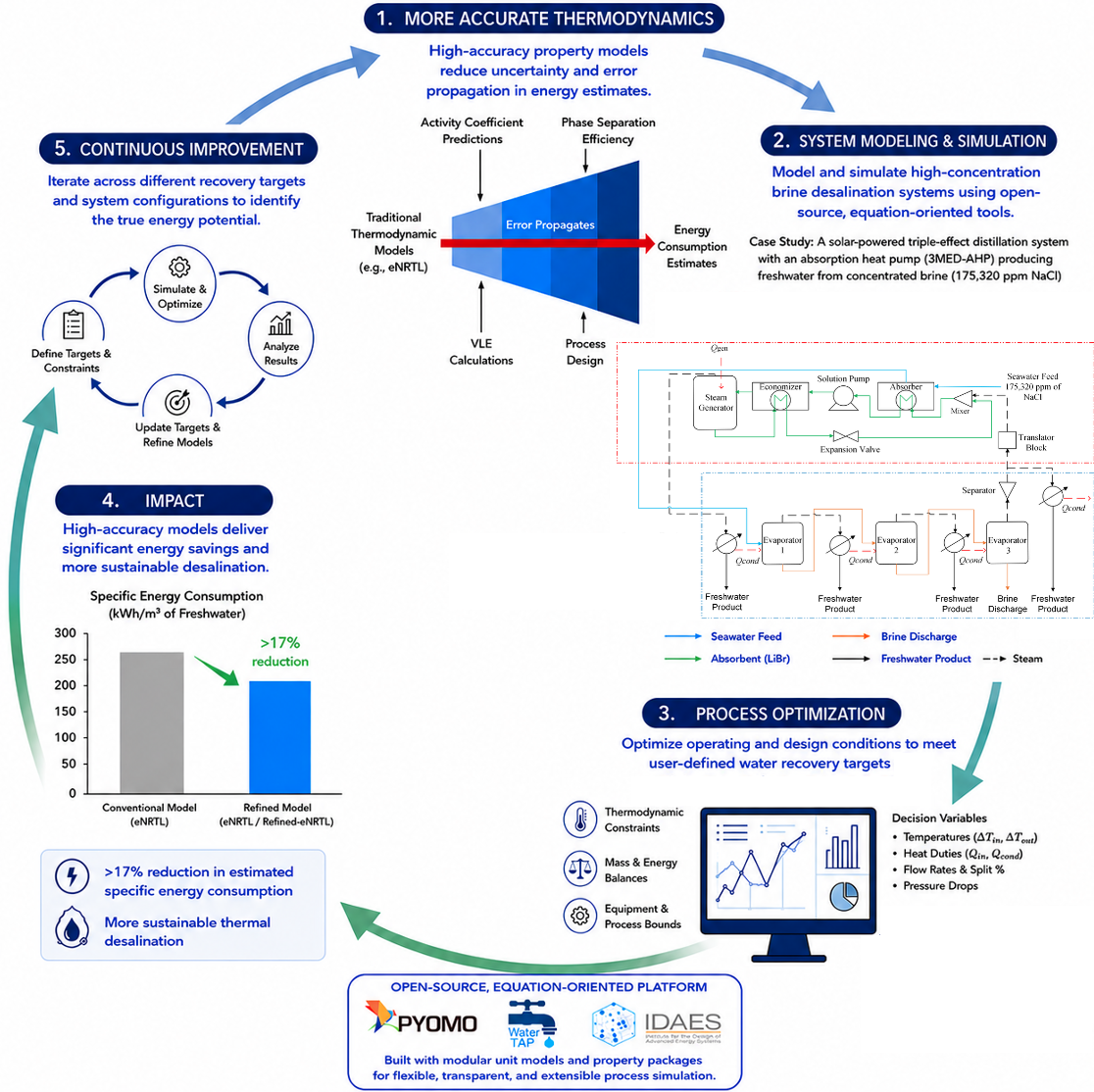
She later contributed to two projects funded by the National Alliance for Water Innovation. One project focused on modeling and simulating high-concentration brine desalination systems using open-source Python-based tools including Pyomo, WaterTAP, and IDAES. Her work demonstrated how the incorporation of more accurate thermodynamic models, which improved predictions of thermodynamic properties, reduced the estimated specific energy consumption of thermal desalination systems by more than 17% compared to conventional methods.

Infographic showing a five-step workflow for improving thermal desalination efficiency using high-accuracy thermodynamic models and process optimization. Step 1 highlights improved thermodynamic property models that reduce uncertainty in energy consumption estimates. Step 2 shows system modeling and simulation of a solar-powered triple-effect distillation desalination system with an absorption heat pump, including a detailed process flow diagram. Step 3 focuses on process optimization using thermodynamic constraints, mass and energy balances, and decision variables such as temperatures, heat duties, and flow rates. Step 4 presents the impact, showing a greater than 17% reduction in specific energy consumption when using refined models compared to conventional models. Step 5 illustrates a continuous improvement cycle of defining targets, simulating, analyzing results, and refining models.
Workflow for advancing a separation system of high brine concentration through refined thermodynamics and process intensification. Illustration by Nazia Aslam.

Innovations in Water Treatment and Future Directions

Desalination plays an increasingly important role in addressing global water scarcity, but many processes are highly energy-intensive and involve complex brine chemistries that are difficult to model accurately. In addition to conducting the research, Nazia also developed reusable software packages and documentation that were made accessible to the broader research community through WaterTAP’s open-source GitHub repository.

More recently, she has been developing interpretable models for long-term membrane fouling prediction using ultrafiltration system data. Membrane fouling remains one of the largest operational challenges in membrane-based water treatment due to its dynamic and multifactorial nature. Nazia’s work aims to improve system management and reduce operational costs by creating models that can better predict fouling trends across operational cycles.

Her current research focus explores large language model-based approaches for discovering governing physics in complex systems.

Because her work spans multiple disciplines, adapting to the pace and breadth of the field has been one of the biggest challenges of her PhD journey.

“Coming from an experimental and industrial background, moving into work that involves coding, modeling, and artificial intelligence felt overwhelming at first,” she said. “I found myself learning new tools and ways of thinking while simultaneously tackling new research challenges.”

Despite these hurdles, she sees the interdisciplinary nature of the field as one of its most rewarding aspects. Her work has the potential to benefit researchers, engineers, industry professionals, and policymakers working to improve the efficiency and sustainability of water treatment systems.

Looking ahead, she hopes to continue pursuing research that addresses real-world challenges while also contributing to expanding educational opportunities in developing communities.

“I believe education empowers individuals to create better opportunities for themselves,” she said.

In addition to her research, Nazia recently became the programming director of the NAWI Next Generation Leadership Council, where she helps lead initiatives that connect students, researchers, and industry professionals through events such as technical webinars. After graduation, she hopes to pursue a research-focused role in either national laboratories or industry.

Nazia’s journey reflects both personal determination and a willingness to step into unfamiliar spaces. What began as a decision to challenge herself has evolved into a career dedicated to solving complex problems and building tools that can make a lasting impact.

Filed Under: Post Tagged With: Freshwater, NextGen, Research, Water

Current reverse osmosis and nanofiltration membranes, which are often extremely delicate and thin, generally do not tolerate waters with suspended solids or high loadings of organics. Pretreatment is nearly always employed to reduce these contaminants which can foul or even abrade membranes. Current pretreatment approaches rely on decades-old technology, are expensive or chemically intensive, and can constitute a majority of the system footprint. They are also difficult to adapt for different treatment systems and typically struggle to entirely prevent fouling.

NAWI’s 5.22 project, “Printed Polyelectrolyte Complex (APEC) Membranes for Ultra-high Permeance Nanofiltration,” aims to create the first nanofiltration (NF) membranes for universal pretreatment. These NF membranes would streamline the pretreatment process to be more efficient across different types of treatment systems or water sources while simultaneously saving costs, energy, and treating more water with better output quality.

This project achieve this using a newly developed additive manufacturing process. This process, known as electrospray,  which uses high voltage to  induce fine, nano-scale sprays to deposit thin and defect-free layers of polymer electrolyte and produce multi-layered membranes with better control. This technique, called “electrospray additive manufacturing,” can form exceptionally thin (~10s of nanometers per layer or less) and defect-free films from any solution-processable polymer.

Electrospray is suited for forming amphiphilic polyelectrolyte complexes (APECs), which bring the positively and negatively charged polymers together to form a material that is both hydrophilic and hydrophobic. These specific properties of APECs create a stronger, adjustable material that better prevents fouling. By using numerous yet exceedingly thin bilayers, the goal of the research is to prevent membrane defects and make pretreatment more efficient, while creating NF membranes with the potential for 5-10 times higher permeance than commercial NF membranes made today.

Filed Under: News, Research Highlight Tagged With: Research, Water, water treatment

NAWI has funded a number of pilot projects that are intended to demonstrate the scaling of new technologies from bench scale or laboratory prototypes to large—and often mobile—field-deployed systems on relevant waters at or near their source. One such pilot project, led by Purdue University, is looking at batch reverse osmosis (BRO).

BRO has been proposed as a more energy-efficient alternative to conventional reverse osmosis (RO), primarily due to the former’s ability to operate closer to the brine’s osmotic pressure during permeate production. In this work, David Warsinger and his team designed, constructed, and tested a pilot-scale conventional RO, closed-circuit RO (CCRO), double-acting reciprocating piston BRO, and bladder-based BRO configurations within the combined system. By using the same pilot system across all tests, the influence of variables such as feed water composition, membrane type, piping, and pump selection is minimized. The pilot system is fully operational and can automatically run using a LabView VI.

The system is designed to handle high-salinity water and is comprised of several components (e.g., check valves, 3-way valves, and 2-way valves). A 5-micron cartridge filter was installed to protect the RO membrane and remove small particles. A feed tank provides the necessary feed water to the system, while separate tanks are used to store the brine and permeate flows. Additionally, different sensors and transducers are used to monitor the main operational variables in the system such as flow rates, pressure, conductivity, pH and temperature.

Experimental results obtained with the pilot system were used to parameterize and validate a predictive model. This model discretizes the membrane module’s feed channel in both the axial and transverse directions to capture the effects of concentration polarization and pressure losses on system performance. By simulating the pressure evolution over time, this model can calculate the system’s specific energy consumption (SEC).

The system has operated continuously for over 900 hours, with seamless switching between configurations. To date, more than 800 million data points have been collected.

The pilot has been operated with different feed salinities (brackish and seawater) and a range of water fluxes and recovery ratios. Preliminary results support previous predictions, showing that CCRO and Batch RO outperform Conventional RO in energy efficiency and achievable recovery.

The results also show that the selected performance indicators are being met with minimal to no leaks observed at operating pressures of up to 1000 psi. Both SEC and the recovery ratio remained within 5% of initial values throughout testing, even after consecutive operating cycles.

For more information, access the project research brief.

Filed Under: News Tagged With: Research, Water, water treatment

When David Warsinger talks about water, it’s never just about water.

It’s about thermodynamics, membranes, microbes, minerals, agriculture, geopolitics — and the quiet urgency of building systems that actually work in the real world.

Now a faculty member at Purdue University, David’s path to leading one of NAWI’s most ambitious desalination pilot projects began years earlier in an MIT conference room, crowded around a whiteboard with . What started as a “side project” during his PhD has since evolved into patented technology, multiple partnerships with startups, international research momentum — and, most recently, NAWI support to build the largest true-batch seawater reverse osmosis (RO) system ever developed.

Rethinking Desalination at Its Core

Conventional reverse osmosis desalination operates continuously: water flows in, pressure stays high, and energy is often wasted by overpressurizing the system. David and his collaborators questioned a foundational assumption — what if desalination didn’t have to be continuous at all?

Instead, they explored batch and semi-batch reverse osmosis, where pressure changes dynamically over time to closely follow the minimum pressure required to desalinate water. This subtle shift turns out to matter a lot.

But there was a catch. A true batch system requires precise, simultaneous control of both pressure and volume — something that hadn’t been solved before at scale. Through persistent whiteboard brainstorming and years of iteration, David and cracked the problem, leading to patented configurations that laid the groundwork for today’s pilot systems.

NAWI Support Enables a First-of-Its-Kind Pilot

With support from NAWI, David’s team at Purdue, Colorado School of Mines, and Oak Ridge National Lab set out to do something bold: build the largest true-batch RO pilot system in the world.

Housed on a 25-foot trailer and operating up to 40–50 gallons per minute , the system is anything but small. The membrane vessels are roughly 10 feet long, the valves are “about the size of a person’s head,” and the main pump and motor weigh nearly 180  pounds. What began as a proposal for a 10-gallon-per-minute system grew — with NAWI’s encouragement and additional resources from collaborator Tzahi Cath’s Department of Defense project — into a five-times-larger, fully modular pilot platform.

The system is designed to compare multiple desalination modes side-by-side: continuous RO, semi-batch RO, true batch RO, and other emerging configurations. It can test seawater, brackish water, high-salinity brines, and even difficult industrial and agricultural wastewaters — making it a flexible testbed for next-generation water treatment.

Beyond Energy: Scaling, and Recovery

Energy efficiency is only part of the story.

Because batch RO cycles salinity up and down every few minutes, it naturally disrupts biofilm formation, a major cause of membrane failure in conventional systems. The rapid salinity changes can cause microbial cells to swell and burst — a phenomenon David’s team has been studying in detail.

Batch operation also opens the door to higher water recovery. Traditional desalination systems avoid operating near salt saturation to prevent scaling and crystallization, which can permanently foul membranes. But batch RO can safely pass through supersaturated conditions for short periods, allowing operators to extract more water from the same feed — an especially valuable advantage for brines, groundwater, and mineral-rich streams.

Applications: Who Benefits First?

While municipal utilities tend to be slow adopters of new technology, David sees near-term impact in industry — particularly sectors that already handle difficult waters.

Critical minerals like lithium and iodine often come from salty brines that are currently concentrated using massive evaporation ponds. Batch RO could dramatically reduce land use, energy demand, and environmental impact in these processes. Agricultural wastewater, industrial reuse, and high-recovery treatment for PFAS and other emerging contaminants are also strong candidates.

Some of this impact is already happening. Variations of David’s batch-inspired designs have been adopted by startups treating animal wastewaters and agricultural flows — with systems now operating at over one million gallons per day.

Scaling Science in a Challenging Funding Landscape

Building hardware-intensive systems on accelerated timelines isn’t easy — especially in today’s uncertain research funding environment. David is candid about the challenges: short pilot timelines, the difficulty of sustaining graduate student support, and the broader consequences of delayed or canceled federal funding.

Yet the urgency only reinforces the stakes.

Water security, critical minerals, agricultural resilience, and energy efficiency are deeply interconnected. Technologies that improve desalination efficiency and recovery don’t just make water cheaper — they help secure food systems, reduce geopolitical vulnerabilities, and protect ecosystems from salinization.

Training the Next Generation

Beyond the technology itself, David is deeply invested in people. His lab has trained an unusually large number of graduate students for an early-career faculty member, many of whom have gone on to faculty roles, startups, and leadership positions in water research.

He also leads outreach efforts with K–12 students, coaches intercollegiate water and marine energy teams, and believes strongly that early exposure to water science shapes future careers.

“If people understand water early,” he says, “they care about it differently.”

Looking Ahead

With NAWI’s support, David’s team is pushing batch reverse osmosis beyond proof-of-concept toward commercialization-ready scale. The goal is simple — and ambitious:

To make desalination and water reuse less energy-intensive, more resilient, and more capable of handling the waters we can no longer afford to ignore.

What began as a whiteboard exercise is now rolling on a trailer, valves humming, membranes cycling — quietly redefining what’s possible in water treatment.

The National Alliance for Water Innovation (NAWI) NextGen Program supports the development of early-career NAWI researchers and members of the alliance to help build a domestic workforce capable of driving future research and development in the water energy sector. Early-career NAWI-affiliated scientists, including graduate students, postdoctoral researchers, and early-career staff members are encouraged to join the program!

Filed Under: Post Tagged With: NextGen, Water

A recent article in the Chemical Engineering Journal details a study of how electromagnetic field (EMF) technology can reduce mineral scaling in water treatment systems and why results vary across applications. Mineral deposits such as calcium carbonate, gypsum, and silica—often called scale—can coat pipes, heat exchangers, and membranes, reducing efficiency, blocking flow, and increasing maintenance and cleaning demands. Conventional chemical antiscalants can be effective but raise concerns about handling, cost, waste, and the long-term complexity of continuous dosing and system monitoring.

The study by NAWI researchers Pei Xu, Xuewei Du, Huiyao Wang, Yanxing Wang, Fangjun Shu, Lawrence  Anovitz, Ke Yuan, and others, shows that EMF treatment can reduce scaling by influencing both minerals suspended in water and crystals growing on surfaces. Bench tests on heat-exchanger and membrane-distillation systems showed fouling dropped by 15–79%, while pilot and field studies in reverse osmosis systems saw scaling fall by 40–45%. EMF effectiveness is highly dependent on water chemistry, system configuration, and operating conditions, which helps explain why some systems see strong results and others see less benefit.

EMF works through two main mechanisms: homogeneous nucleation in the bulk solution and heterogeneous crystal growth on surfaces. The study also explores how EMF strength, frequency, waveform, and flow velocity affect outcomes. By combining pilot-scale experiments and modeling simulations, the study shows how adjusting these parameters can optimize performance for different water treatment setups.

EMF systems operate without chemicals, produce no secondary waste, and require minimal energy. Case studies in cooling towers and reverse osmosis systems show reduced cleaning downtime, energy savings, and longer water reuse before blowdown or discharge. The study notes that hybrid approaches, combining EMF with low-dose antiscalants, may further improve reliability and cost-effectiveness, but systematic testing is needed to confirm performance and compatibility.

The authors conclude that EMF shows real potential for chemical-free scale control, but its effectiveness depends on a clear understanding of how it affects mineral behavior in water and how deposits attach to surfaces. Although long-term, full-scale validation and standardized testing protocols are still needed, the study sheds light on the mechanisms and operational factors that drive performance. By clarifying how EMF interacts with different water chemistries and system conditions, the study highlights the circumstances under which EMF could provide a reliable, cost-effective approach to reducing mineral scaling in a range of water systems.

Filed Under: News Tagged With: Research, Water, water treatment

Exploring how tiny chemical structures can tackle big environmental challenges, from PFAS contamination to resource recovery.

What makes a material truly effective—and how can those insights spark the next generation of solutions? That’s the question NAWI researcher Ethan Pezoulas and his team are answering by moving beyond material design to uncover the principles that drive performance.

For Ethan, an interest in water started long before graduate school—shaped by years spent outdoors in Alberta, Canada. “I grew up hiking, camping, skiing, and playing hockey,” he says. “I was surrounded by rivers, lakes, and snow-fed streams. You can’t spend that much time outdoors and not start thinking about how vital water is—and how we manage it.”

After earning his BSc in Chemistry from the University of Calgary, Ethan moved to Berkeley to join the Jeff Long research group at UC Berkeley. Now in his fifth year of a  Chemistry PhD program, he reflects: “I’ve been loving it.” His academic path was driven by curiosity and a desire to bridge two worlds—fundamental chemistry and real-world impact. “I like knowing the fundamental chemistry, but what’s most satisfying is applying it to real-world problems,” he says.

That mindset defines Ethan’s work today. “The overarching theme of my research is developing porous materials for aqueous separations of environmental and economic importance,” he explains. In simple terms, Ethan creates tiny structures with chemical ‘hooks’ that latch onto specific substances. He then builds these into porous materials—like advanced sponges—that can pull certain contaminants out of water while letting everything else pass through.

Within his NAWI project, Ethan is tackling two major challenges: removing selenium and PFAS from water. PFAS—often called “forever chemicals”—are persistent, harmful substances found in nearly every water source on the planet. Selenium, while essential in trace amounts, can be toxic at higher concentrations and is a growing concern in wastewater from agriculture and industry.

Ethan’s materials work by selectively binding these contaminants, pulling them from water while leaving behind what’s safe. And here’s the breakthrough: by studying why these chemical modifications work so well, Ethan and his team discovered design principles that can be applied beyond their current system.

“In theory, you could take what we learned about the chemical modifications and apply it to different frameworks or different sponges that might be better suited for other applications,” Ethan explains.

That insight turns a single innovation into a platform for many—enabling next-generation adsorbents that could address a wide range of water challenges.

For Ethan, this isn’t just academic achievement; it’s part of a bigger vision. “I want to keep doing research for direct application—taking what we know and applying it to real-world solutions,” he says. While he values fundamental science, his passion lies in innovation that makes a difference. “It’s satisfying to know the principles behind something, but the real excitement comes when you can see it making an impact.”

The National Alliance for Water Innovation (NAWI) played a pivotal role in this journey. Beyond funding, NAWI provided clarity on priorities, access to resources, and a network of collaborators. “NAWI gave us direction and connected us with a community. Those conversations and partnerships have been just as important as the research itself,” Ethan notes.

Outside of NAWI, Ethan is exploring how to recover critical minerals—such as precious metals or rare earth elements—from the chemical solutions left over after recycling electronics, magnets, and batteries. “Instead of mining raw materials, which can be environmentally destructive, we can recover critical elements from existing waste streams,” he says. This not only supports sustainability but also strengthens supply chains for clean energy technologies.

As he looks ahead, Ethan is leaning toward industry—where fundamental research can become products that change how water is treated worldwide. His work is a reminder that understanding the science behind performance isn’t just academic—it’s the key to unlocking cleaner, safer, and more sustainable water technologies for the future.

The National Alliance for Water Innovation (NAWI) NextGen Program supports the development of early-career NAWI researchers and members of the alliance to help build a domestic workforce capable of driving future research and development in the water energy sector. Early-career NAWI-affiliated scientists, including graduate students, postdoctoral researchers, and early-career staff members are encouraged to join the program!

Filed Under: Post Tagged With: NextGen, Water

Hannah Holmes’s journey from a small town in southern Illinois to the research labs at Stanford University was driven by curiosity and a passion for making science meaningful, especially for communities like the one where she grew up.

Raised in a town of just 4,000 residents, she had little early exposure to science. That changed in high school when a chemistry class sparked her curiosity. Her interest grew after shadowing a female chemical engineer at the oil refinery where her father worked. Inspired by the field’s use of science and math to solve real-world problems, she went on to study chemical engineering at the University of Illinois Urbana-Champaign.

Hannah’s academic path has spanned several scientific areas, all of which have focused on pollutant removal and reuse. At the University of Illinois, she worked on electrochemical processes that transform carbon dioxide into fuels and chemicals. During her Ph.D. studies at Georgia Tech, her research centered on carbon capture from air or flue gas. After a post-seminar conversation with Stanford’s Will Tarpeh, she shifted her focus to water-based separations, leading to her current role as a postdoctoral researcher in his lab.

At Stanford, she is developing electrochemical processes to recover nutrients from wastewater. Her work involves building low-impact systems to recover critical nutrients like phosphate, an essential component of agricultural fertilizers. After fertilizer application, excess nutrients carried by irrigation or rainfall to lakes and reservoirs can cause large algae blooms, which harm both the environment and human health. A key project uses a hybrid electrochemical ion exchange process to recover phosphate as fertilizer through electrochemical regeneration, a lower-carbon, more cost-effective alternative to conventional chemical methods. She explains, “By recovering phosphate as fertilizer, we can close the loop and transform pollutants back into valuable products.”

What sets her research apart is its multi-scale approach. One day she might analyze molecular-level adsorption mechanisms with synchrotron tools; the next, evaluate broader impacts through technoeconomic and life cycle analysis. This range allows her to approach each challenge from both molecular and systems-level perspectives. She notes that while adsorbent and electrochemical processes have been scaled independently, integrating them shows great promise. “There’s a path forward for integrated systems,” she says.

Her interest in environmental technologies is rooted in a pivotal undergraduate lecture on the disproportionate effects of climate change on rural areas. “I wanted to use my chemical engineering background to help places like my hometown,” she recalls.

Looking ahead, Hannah hopes to expand her work to other pollutants—both gaseous and aqueous—and envisions “refineries of the future” that turn waste into valuable products using scalable, energy-efficient technologies. But she acknowledges that technical innovation alone is not enough. “We still need buy-in from funders and treatment facilities,” she says, citing the inertia and limited incentives that can slow real-world adoption.

Although her work is highly technical, Hannah emphasizes the human side of science. She values in-person interactions—especially at conferences—for building authentic, lasting relationships. As a member of the National Alliance for Water Innovation (NAWI) NextGen Leadership Committee, Hannah recently helped lead a mixer during the NAWI quarterly review meeting to encourage interaction and collaboration among graduate students, postdocs, and early-career water researchers.

Mentorship plays a central role in Hannah’s life. As an undergraduate, she was placed in a program for students considered less likely to succeed. That experience, and the support it provided, helped define her approach to science and mentoring. “Everything I’ve accomplished is because mentors positively influenced the trajectory of my life, and I would love to provide that same support for others,” she says. “Mentoring students and seeing them advance on their own paths is one of my proudest achievements.”

In fall 2025, she will lead the mentorship program for the NAWI NextGen Leadership Committee. She is eager to involve mentees in the process and help early-career researchers connect and grow. As part of the program last year, Hannah advised Ph.D. students on maximizing productivity, finding early-career positions, and achieving a healthy work-life balance. As for the latter, she shares straightforward advice for Ph.D. students: “Take breaks, get outside, and stay proactive about communication with your mentor and collaborators.”

Outside the lab, Hannah enjoys walking around campus, spending time in nature, and playing with her cat, Friday. During the final year of her Ph.D., a visit to Climeworks’ direct air capture facility in Switzerland reminded her that the technologies she works on aren’t just theoretical—they are already being deployed. The site, one of the world’s first commercial-scale direct air capture plants, used modular units to extract carbon dioxide directly from the atmosphere for storage or reuse.

As she prepares to apply for faculty positions in chemical engineering, she stays focused on what initially drew her to science—curiosity and a desire to make a difference—along with what has sustained her commitment: mentoring the next generation of scientists and engineers.

Filed Under: Post Tagged With: NextGen, Water

The National Alliance for Water Innovation (NAWI), which is led by the Department of Energy’s (DOE) Lawrence Berkeley National Laboratory (Berkeley Lab), has been extended for five more years with $75 million in funding from DOE. NAWI will continue its contributions to helping decarbonize the water and wastewater sectors through investments in technologies that enhance the efficient use of energy for water use, treatment, and distribution.  

“Water and energy are interdependent—water is used to produce nearly every major energy source, and energy is critical to transporting and treating water,” said Jeff Marootian, Principal Deputy Assistant Secretary in the Office of Energy Efficiency and Renewable Energy. “The deep connection between these two resources demands an integrated approach that considers the challenges and opportunities inherent to both sectors. The Department of Energy is proud to be leading the nation’s efforts to decarbonize the water economy, while ensuring a secure water future for communities nationwide.”

Over the next five years, NAWI is shifting its focus to include regional water systems planning – and will partner with water planners at the state and regional level to develop and use new tools for water supply forecasting, water demand forecasting, and water portfolio optimization. NAWI will also spearhead water resilience pilot projects and implement regional water system workshops. These new directions will enable NAWI to continue to accelerate breakthroughs towards a circular water economy, where water is treated to fit-for-purpose standards and reused locally, rather than transporting freshwater long distances. 

“Desalination and innovative water treatment technologies hold great promise for helping us meet our planet’s growing demand for one of our most precious resources: water,” says Mike Witherell, Director of Lawrence Berkeley National Laboratory. “The Department of Energy’s renewed support for NAWI enables the continuation of cutting-edge research and development which is needed to not only treat unconventional sources of water for re-use but to lower their cost and energy use.” 

Over the past five years, NAWI has supported a robust research portfolio with 60 original and innovative research and development projects that span analysis for water-energy grid integration to the development of algorithms, models, and adaptive process controls for resilient operations. In addition, NAWI has supported the implementation of 11 pilot projects that have begun work demonstrating some of these innovative technologies in real-world environments. NAWI has also developed the NAWI Alliance with over 1,670 members, and partnered with over 420 leading industry, academic, and government stakeholders. NAWI has also developed a suite of knowledge products, including a master roadmap and series of industry-specific roadmaps to prioritize the highest impact technology options, and its 60 projects support those priorities. To date, NAWI researchers have published more than 100 articles in high-impact research journals. 

“Our research program remains steadfast in its commitment to reducing the price, energy cost, and greenhouse gas emissions of new water technologies,” said Peter Fiske, Executive Director of NAWI. “Our work also bridges cutting-edge research with real people and places, such as producing secure, reliable, and affordable water for communities that are most in need.”

Throughout the next five years, NAWI will remain committed to the principles of Inclusion, Diversity, Equity, and Accountability (IDEA). NAWI’s pilot projects will continue to treat unconventional water sources to provide usable water in real-world environments. Some of the pilot projects will partner directly with communities and groups that have historically been underserved by existing water supplies. Each project will also generate a range of data sets usable by other researchers seeking to advance the field of data analysis and automation, and fault detection in water treatment systems.

NAWI’s plan for the next five years aligns well with the California’s Water Supply Strategy (WSS) – Adapting to a Hotter Drier Future, which outlines a strategy and priority actions to adapt and protect water supplies from the effects of rising temperatures and drier conditions due to climate change. The California Water Plan is the State’s strategic plan for sustainably and equitably managing and developing water resources for current and future generations. Key actions include enhancing water conservation efforts and accelerating innovation related to water treatment, reuse, and desalination.

“Securing a more resilient water future for California means investing and building meaningful relationships with key partners like NAWI. This collaboration will help drive innovation for new, affordable water supplies for a more water resilient future for generations to come,” said California Department of Water Resources Director Karla Nemith.

The next phase of NAWI also aligns with the California Water Plan Update 2023 (Update 2023), which champions climate resilience throughout various regions and water sectors by offering a comprehensive approach. This approach includes a statewide vision, well-defined goals, a watershed planning framework, a versatile toolkit, and a dashboard for tracking progress indicators.

“Regional water systems planning is critical to addressing questions of where, when, and how non-traditional source waters are most effectively deployed for enhanced U.S. water security,” said Meagan Mauter, Research Director of NAWI. “Regional systems models also help to establish the value of desalination technology innovation, linking the R&D NAWI performs on new nanoscale materials or intensified processes to dollars saved and carbon saved. The balance of our program will continue to advance device and treatment research investments from the first 5 years of NAWI, including a focus on cost effective, energy efficient desalination technologies and advanced data, modeling, and control systems for complete treatment trains.”

The NAWI program will significantly contribute to the implementation of the updated water plan, demonstrating novel methods for water reuse at the community and premise scale, along with further advancing key reuse technologies such as desalination and fit-for-purpose treatment. NAWI will support California and the nation to in their efforts to keep pace with the impacts of climate change, facilitating smarter and swifter updates to its water systems.

“The next five years present an invaluable opportunity to deliver impact aligned with NAWI’s pipe parity metrics and further the country towards net-zero emissions by 2050,” said Fiske.

NAWI will continue to be supported by the DOE Office of Energy Efficiency & Renewable Energy’s Industrial Efficiency and Decarbonization Office. 

###

NAWI is a research program and public-private partnership supported by the United States Department of Energy in partnership with the California Department of Water Resources and the California State Water Resources Control Board. NAWI brings together a world-class team of industry and academic partners to examine the critical technical barriers and research needed to radically lower the cost and energy of desalination. NAWI is led by DOE’s Lawrence Berkeley National Laboratory in collaboration with the National Renewable Energy Laboratory, Oak Ridge National Laboratory, National Energy Technology Laboratory, and the SLAC National Accelerator Laboratory and funded by the Office of Energy Efficiency and Renewable Energy’s Industrial Efficiency and Decarbonization Office and Water Power Technologies Office.

Additional information:

  • For additional information about joining NAWI, visit the NAWI Alliance Membership Application. 
  • For additional information about NAWI’s research and projects, visit NAWI’s projects.
  • For additional information about NAWI’s knowledge products, visit NAWI’s publications and data.

Filed Under: Media Coverage, News Tagged With: Energy, Freshwater, Research, Water

NAWI Research Director Meagan Mauter and NAWI Deputy Topic Area Lead for Materials and Manufacturing Jeff McCutcheon authored an article for Science that highlights why materials discovery alone has not translated into lower-cost water treatment. The publication emphasizes that the enduring dominance of traditional reverse osmosis membranes reveals a broader need within the water treatment community to reassess the innovation pipeline for membranes for desalination and water treatment. Read the article.

Filed Under: Media Coverage, Post Tagged With: Energy, Freshwater, Research, Water

The U.S. Department of Energy (DOE) and the National Alliance for Water Innovation (NAWI), in collaboration with the California Department of Water Resources, today announced the selection of 11 projects for negotiation that will pilot breakthrough technologies and systems that will allow for more reliable and affordable freshwater supplies for the United States. The projects will also contribute to the decarbonization of the water and wastewater sectors through investments in technologies that enhance the efficient use of energy in the use, treatment, and distribution of water.

The selected pilot projects will process non-traditional source waters from a range of locations and produce water in real-world environments. In some cases, projects will partner directly with communities and groups that have historically been underserved by existing water supplies. The research will help to bolster a circular water economy by supporting water reuse and valorizing constituents we currently consider to be waste. Each project will also generate a range of data sets usable by other researchers seeking to advance the field of data analysis and automation, and fault detection in water treatment systems.

The collaborative project teams of industry, academic, national laboratory, and other stakeholders will deliver impact aligned with NAWI’s pipe parity metrics. Pipe parity is defined as technology solutions for treating and reusing nontraditional water sources that are competitive with conventional water sources for specific end use applications.

These pilot systems will directly address the highest priority research needs and technical knowledge gaps outlined in the NAWI Roadmap Publication Series, which was published in 2021.

The selected projects include:

(Listed in no particular order)

  • Concentrate Treatment and Chemical Production Using Innovative Electrodialysis Processes for Near Zero-Waste Discharge

Desalination technologies typically extract a fraction of pure water and leave behind a salty residual liquid called brine or concentrate that is expensive and difficult to dispose of at inland desalination facilities. This project is focused on the design and build of a novel process to further concentrate the brine using electrodialysis, producing more water and transforming the dissolved salts into valuable industrial chemicals. The pilot system will be fielded at the Kay Bailey Hutcheson Desalination Plant in El Paso, Texas.

Partners: New Mexico State University (lead); Veolia Water Technologies and Solutions, Inc.

  • Switchable Solvent ZLD Process for Solving the Inland Desalination Brine Problem

Desalinating and reusing municipal, industrial and agricultural wastewater is an attractive approach for improving the reliability and resilience of water resources. But the presence of dissolved minerals that can plug RO membranes and modules (a process called scaling) limits the amount of water that can be recovered using membrane processes such as RO. This project aims to integrate a novel, high-efficiency process for removing scale-forming ions from brine concentrates, enabling much higher amounts of water recovery and smaller volumes of waste brine. The mobile testbed will demonstrate high-recovery desalination at five sites in California.

Partners: Global Water Innovations, Inc. (lead); Trevi Systems, Inc.

  • Mobile Test Bed for Marginal Water Filtration

Water pre-treatment (before desalination) remains a critical process step for maximizing water production and lowering desalination cost. Current pretreatment technologies are large, slow, and multi-step, making them suitable for large desalination projects but clumsy and less effective for small-scale systems. This project will integrate a novel high-performance nanofiltration membrane system as pretreatment alongside two variants of electrocoagulation as a high-efficiency, all-electric pretreatment strategy. The mobile testbed developed by this team will travel to several sites around Albuquerque, New Mexico, evaluating high-efficiency desalination of different non-traditional water sources.

Partners: Garver USA (lead); City of Rio Rancho, New Mexico; the University of California, Los Angeles; NX Filtration, University of Colorado-Boulder; WaterTectonics, Inc; Rockwell Automation; Powel Water

  • Salt-Free Electrodialysis Metathesis (EDM) for High-Recovery Concentrate Management

Electrodialysis Metathesis (EDM) is a desalination process that uses specialized membranes and chemistry to produce fresh water while transforming the residual brine into two streams – a calcium-rich solution and a sulfate-rich solution. These two streams can be further refined into valuable industrial chemicals, producing a secondary revenue stream from desalination – and reducing the volume of waste brine. Until now, EDM has required the addition of sodium chloride (NaCl) to supply required ions for these solutions. In this project, a new ion-selective membrane technology will be utilized that will eliminate the need for additional NaCl and may lower the energy requirements of traditional EDM by as much as 50%. The system will be tested at the U.S. Bureau of Reclamation’s Brackish Groundwater National Desalination Research Facility (BGNDRF) in Alamogordo, New Mexico.

Partners: University of Texas, El Paso; New Mexico State University

  • UHP-CCRO with Virtual Curtain to Achieve Minimal Liquid Discharge

Softening is the process of removing certain ions from water that otherwise precipitate during the desalination process, limiting the amount of water that can be recovered from inland brackish water sources using RO. This project proposes to use a novel softening technology to selectively remove these scale-forming ions by forcing the precipitation in the form of hydrotalcite – a mineral that is made from these ions – that could be used as a soil amendment or as an additive for concrete.

Partners: Jacobs Engineering (lead); New Mexico State University; Commonwealth Scientific and Industrial Research Organisation; DuPont

  • Mobile Demonstration DPR: Comparison of RO and non-RO DPR for aerobic and anaerobic effluents

Municipal wastewater can be reprocessed into drinking quality water. Reverse osmosis (RO) has traditionally been a final treatment step that can provide the high purity required to satisfy drinking water quality regulations, but RO generates a brine waste stream and drives up the cost and energy required for direct potable reuse (DPR). This project will perform a side-by-side demonstration at Silicon Valley Clean Water’s treatment plant in Redwood City, California, of both an RO-based treatment train and a novel treatment train that achieves nearly the same purity without using RO. The team will also investigate how different types of wastewater treatment technologies produce effluents that are either easier or harder to transform into drinking quality water.

Partners: Colorado School of Mines (lead); Stanford University; University of Colorado, Boulder

  • Piloting an Electrical, Modular, and Distributed ZLD Arsenic-Removal Technology

Arsenic is a pervasive, naturally occurring carcinogenic contaminant in groundwater. Thousands of wells in California and around the world have arsenic levels that exceed safe levels, forcing communities to install expensive and hard-to-operate treatment systems or shutter their local wells and travel miles to fill water jugs for home use. This project will demonstrate a new simple, reliable and highly automated electrochemical process that uses iron and electrical current to safely remove arsenic in well water. The team will partner with the community of Allensworth, California, a rural community whose residents must drive miles to pay for retail water from a kiosk.

Partners: University of California, Berkeley (lead); Allensworth Progressive Association

  • Reciprocating Piston Batch Reverse Osmosis: Pushing the limits of efficiency and fouling resistance

Conventional reverse osmosis utilizes high pressure pumps to continuously supply pressure into RO modules and generate fresh water. This steady-state process can result in the gradual build-up of organic and inorganic precipitates on membrane surfaces (known as fouling), which reduces water production and requires frequent cleaning. This project will demonstrate a novel batch-mode process whereby RO modules are pressurized using a piston-based pump and fresh water is produced in a non-continuous process. This approach to reverse osmosis not only uses less energy but may also greatly reduce the rate of fouling of membrane surfaces.

Partners: Purdue University (lead); Colorado School of Mines; Oak Ridge National Laboratory

  • Integrated Counter-Flow Reverse Osmosis Treatment for High-Salinity Produced Water

High salinity produced water is predominant in U.S. oilfields. Reverse osmosis (RO) has been used to desalinate low-salinity produced water, but has a salinity limit below that of most U.S. produced waters. This project will field a novel advancement that uses commercial RO membranes and infrastructure, and counterflow RO (CFRO) in order to enable treatment of high salinity water by managing the osmotic pressure differential across the membranes of sequential stages in a counter-flow arrangement.

Partners: Aris Water (lead); New Mexico State University; Texas Agricultural and Mechanical University; Stanford Linear Accelerator Center; Garver, OLISoft, Inc.

  • Field Pilot Testing of Electrically Conductive Reverse Osmosis (ECRO) Membranes for High Mineral Content Brackish Groundwater Desalination

Unconventional and difficult-to-treat water resources, such as brackish groundwater, have complex chemistries, and treating them to freshwater levels requires complex processes consisting of multiple stages of pre-treatment followed by membrane desalination, making them costly and difficult to operate which limit their widespread application and adoption by society and various industries. Both ECNF and ECRO use combinations of applied electrical fields and in situ electrochemical generation to actively resist membrane fouling – the deposition of particles onto membrane surfaces that causes pore clogging and diminished performance over time. The project will operate the pilot system as two parallel trains to evaluate the head-to-head performance of ECRO compared with conventional RO at Sand City, California.

Partners: Pacific Water Solutions, Inc.

  • A Convergent Monitoring Platform for Dynamic Characterization of Reverse Osmosis Membrane Fouling and Demonstration of Innovative Control Strategies

Membrane fouling and scaling is a pervasive and costly aspect of many membrane-based water treatment systems. This project will demonstrate and validate an unprecedented sensing/time series monitoring system at Orange County Water District for the dynamic characterization of reverse osmosis (RO) biofouling, mineral scaling, and organic fouling. The data obtained from this system will be combined with pilot and full-scale RO performance data to train next-generation Machine Learning (ML) and Artificial Intelligence (AI) models to better forecast and mitigate fouling and scaling. This project will also evaluate novel sensor technologies and a new commercial membrane technology that can resist the application of oxidizing cleaning chemicals.

Partners: Rice University (lead); University of Texas, Austin; University of Tennessee, Knoxville; Oak Ridge National Laboratory; Orange County Water District; Noria Water Technologies, Inc., NALA Membranes, Inc.; Carollo Engineers

NAWI is a public-private partnership that brings together a world-class team of industry and academic partners to examine the critical technical barriers and research needed to radically lower the cost and energy of desalination. NAWI is led by DOE’s Lawrence Berkeley National Laboratory in collaboration with National Energy Technology Laboratory, National Renewable Energy Laboratory, and Oak Ridge National Laboratory, and is funded by the Office of Energy Efficiency and Renewable Energy’s Industrial Efficiency and Decarbonization Office.

Filed Under: News Tagged With: Energy, Freshwater, Research, Water

The U.S. Department of Energy (DOE) and the National Alliance for Water Innovation (NAWI) today announced the selection of seven projects that will advance breakthrough technologies for reliable and affordable freshwater supplies for the United States. The selected projects will conduct early-stage applied research on desalination and treatment of nontraditional water sources for beneficial end uses. The research will help to bolster a circular water economy by supporting water reuse and valorizing constituents we currently consider to be waste.

The collaborative project teams of industry, academic, national laboratory, and other stakeholders will deliver impact aligned with NAWI’s pipe parity metrics. Pipe parity is defined as technology solutions for treating and reusing nontraditional water sources that are competitive with conventional water sources for specific end use applications.

The research will directly address the highest priority research needs and technical knowledge gaps outlined in the NAWI Roadmap Publication Series, which was published in 2021. The projects focus on addressing challenges related to either autonomous water or precision separation. The autonomous water challenge area aims to develop sensor networks and adaptive process control for improved water desalination treatment systems. The precision separation challenge area aims to develop flexible platform technologies that remove (and/or recover) target compounds from one or more priority classes of contaminants and from specific water end use sectors.

The selected projects include:

(Listed in no particular order)

  • Energy-Efficient Selective Removal of Metal Ions from Mining Influenced Waters Using H-Bonded Organic-Inorganic Frameworks

The H-Bonded Organic-Inorganic Frameworks technology will bring tremendous value into the treatment of nonconventional waters with reduced energy consumption, system complexity, and waste management costs while providing unmatched brine valorization and profit recovery. The precision separation and recovery of metals in acid mine drainage (AMD) waters may also expand the availability of critical materials and help alleviate dependency on metal supply chains for the U.S.

Partners: Rio Tinto Services Inc. (lead), Lawrence Berkeley National Laboratory, University of Oklahoma, California Department of Water Resources (funding partner)

  • Data-Driven Fault Detection and Process Control for Potable Reuse with Reverse Osmosis

This project will use machine learning and artificial intelligence to reduce energy and chemical use, improve operational support, increase treatment system uptime, and improve confidence in purified water quality.

Partners: Carollo Engineers, Inc. (lead), Yokogawa Corporation of America, National Water Research Institute, U.S. Military Academy West Point, tntAnalysis, Las Vegas Municipal Water District, Metropolitan Water District of Southern California, West Basin Municipal Water District, Orange County Water District, Baylor University, California Department of Water Resources (funding partner)

  • Multifunctional Membrane for Oxyanion Removal

This project will generate a technology that enables the selective removal and recovery of metals/oxyanions from water, enabling the use of a non-traditional water source, significantly reducing the cost and energy of treatment, and valorizing compounds that would typically be considered waste.

Partners: University of California, Berkeley (lead), Greeley and Hansen LLC, NTS Innovations Inc., California Department of Water Resources (funding partner)

  • Copper Recovery from Mining Process Waters with Ion-Selective Electrodialysis

Copper recovery will help to achieve pipe parity with conventional treatment of mining process waters and/or reuse at copper mines and refineries while simultaneously improving environmental sustainability. The project will also provide platform technology that can be used to develop additional ion-selective cation exchange membranes, targeting other ionic contaminants of interest, such as lead and cadmium.

Partners: Rice University (lead), The University of Texas El Paso, Magna Imperio Systems Corp.

  • Novel Bipolar Membrane Assisted Electrosorption Process for the Selective Removal of Boron

This project will overcome the persisting inefficiencies in the current state-of-the art boron removal strategies. The research will also provide a demonstration of an effective method for electrosorption of weak acid/base species and selective removal of trace contaminants.

Partners: Yale University (lead), University of Michigan, Magna Imperio Systems Corp.

  • Redox-Mediated Electrodes for Precision Separation of Nitrogen and Phosphorus Oxyanions

Selective electrosorption technologies for the separation and concentration of charged nutrients could enable a sustainable water treatment paradigm, particularly for small communities that struggle to operate centralized facilities and highly sensitive biological removal systems. 

Partners: University of Illinois at Urbana-Champaign (lead), Lawrence Livermore National Laboratory, Oak Ridge National Laboratory, Voltea Inc.

  • Selective Electrocatalytic Destruction of PFAS using a Reactive Electrochemical Membrane System

This project will overcome technical limitations of existing per- and polyfluoroalkyl substances (PFAS) destruction technologies by improving selectivity for PFAS destruction, minimizing toxic byproduct formation, and limiting short-chain PFAS formation.

Partners: University of Illinois Chicago (lead), Purdue University, Argonne National Laboratory, M. Davis & Sons Inc., Trimeric Corporation, CDM Federal Programs Corporation, Orange County Water District

NAWI is a public-private partnership that brings together a world-class team of industry and academic partners to examine the critical technical barriers and research needed to radically lower the cost and energy of desalination. NAWI is led by DOE’s Lawrence Berkeley National Laboratory in collaboration with National Energy Technology Laboratory, National Renewable Energy Laboratory, and Oak Ridge National Laboratory, and is funded by the Office of Energy Efficiency and Renewable Energy’s Industrial Efficiency and Decarbonization Office.

Filed Under: News Tagged With: Energy, Research, Water

Primary Sidebar

National Alliance for Water Innovation (NAWI)

Footer

  • About
  • Who We Are
  • Our Team
  • Our Partners
  • Contact Us
  • Join Us
  • Consortium Documents
  • NAWI Network FAQs
  • Research & Projects
  • Projects
  • Process Innovation and Intensification
  • Materials and Manufacturing
  • Data Modeling and Analysis
  • Devices
  • Regional Water Systems
  • Treatment Trains
  • Funding
  • Opportunities
  • Resources
  • Acknowledgments, Credit Lines, and Disclaimers
  • Funding FAQs
  • Publications & Data
  • Academic Publications
  • Roadmap Report Series
  • WaterTAP | Tool
  • Water DAMS | Data
  • Acknowledgments, Credit Lines, and Disclaimers
  • News & Stories
  • News
  • Blogs and Stories
  • Multimedia
  • Media

Join Us on Social Media

Privacy & Security Notice
National Alliance for Water Innovation (NAWI) is an Energy-Water Desalination Hub funded U.S. Department of Energy (DOE), Office of Critical Minerals and Energy Innovation (CMEI), Industrial Technologies Office (ITO), and the Hydropower and Hydrokinetic Office (H2O), under Funding Opportunity Announcement Number DE-FOA-0001905.
 Share This

Share on Mastodon