
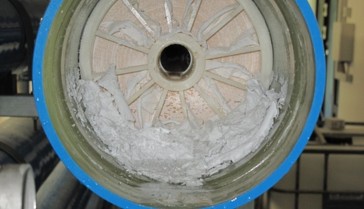
Conventional scale mitigation methods—anti-scalant addition, ion-exchange resins, and solvent extraction—require significant chemical or thermal inputs, which complicate brine management. While electrodialysis (ED) can potentially separate mono- and divalent ions, current membranes lack the selectivity needed for effective scaling control.
This project, led by Jovan Kamcev at the University of Michigan with partners at Lawrence Berkeley National Laboratory and Veolia WTS, focuses on developing highly selective ion-exchange membranes to improve ED pretreatment for brackish water reverse osmosis (BWRO). The developed membranes could enable high-recovery BWRO processes that are chemical-free and energy-efficient, improving brackish water desalination sustainability and reducing concentrate management challenges.
These membranes were tested in bench-scale ED systems to determine their ability to reduce scaling potential in RO processes. Process modeling was employed to optimize operational parameters, including water recovery and energy consumption, for maximum efficiency.
Testing revealed that divalent-selective single-layer membranes achieved Ca²⁺/Na⁺ selectivity values of approximately 4 at low current densities, a performance level notably higher than that of commercial membranes. Monovalent-selective bilayer membranes exhibited extremely high Na⁺/Ca²⁺ selectivity across various brackish water chemistries; however, their ion transport fluxes were about an order of magnitude lower, reflecting the reduced limiting current density inherent to the design. Membranes featuring sulfonate and phosphate functional groups demonstrated the best Ca/Na separation factors under realistic brackish water compositions, indicating strong potential for practical scaling control.
Following bench-scale validation, the membranes will be scaled up for pilot plant demonstrations in collaboration with an industrial partner. A technoeconomic analysis will also be conducted to evaluate the commercial viability and overall feasibility of these pretreatment solutions.
The next phase will focus on conducting ED experiments using larger membrane stacks, with findings intended to calibrate the ED process model developed by WaterTAP. This progression marks a significant step toward bridging bench-scale insights with pilot-scale application readiness.
Access the project poster for more information.