
• Skip to primary navigation
  • Skip to main content
  • Skip to primary sidebar
  • Skip to footer
National Alliance for Water Innovation (NAWI)

National Alliance for Water Innovation (NAWI)

Innovating for a water and energy secure future for the United States

  • About
    • Who We Are
    • Our Team
    • Our Partners
    • Contact Us
  • Research & Projects
    • Projects
    • Process Innovation and Intensification
    • Materials and Manufacturing
    • Data Modeling and Analysis
    • Devices
    • Treatment Trains
    • Regional Water Systems
  • Publications & Data
    • Academic Publications
    • Roadmap Report Series
    • WaterTAP | Tool
    • Acknowledgments, Credit Lines, and Disclaimers
  • Join Us
    • Consortium Documents
    • NAWI Network FAQs
  • Funding
    • Opportunities
    • Resources
    • Acknowledgments, Credit Lines, and Disclaimers
    • Funding FAQs
  • News & Stories
    • News
    • Blogs and Stories
    • Multimedia
    • Media
  • Join

Lauren Nicole Core

NAWI’s theory of action is based on the belief that technical innovation is most impactful when it is performed in context. Materials are contextualized within a process; processes are contextualized within treatment trains; treatment trains are contextualized within water systems. While pandemic shut-downs have had minimal effect on our materials and process development projects, we have sorely missed the opportunity to visit water system operators. Pre-pandemic visits to Carlsbad West Basin Water District in LA and the Kay Bailey Hutchison Desalination Plant in El Paso, Texas allowed us to learn about non-traditional source water treatment trains designs, operational challenges, and economic benefits for water users.  

So it was tremendously exciting when federal travel restrictions were eased in March and we were finally able to resume NAWI field trips. Our first three visits were to Trevi Systems, a NAWI project performer working on concentrate management in Petaluma, CA; Red Rocks community college, the site of a USBR pilot facility for reusing cooling water blowdown; and Dr. Tzahi Cath’s Direct Potable Reuse (DPR) trailer, then located in Colorado Springs. Visits to each site provided an opportunity to see NAWI technologies (or related unit processes) in action, hear directly from operators about the challenges and opportunities for low TRL research to make a difference in the cost and energy intensity of their treatment trains, and brainstorm creative new ideas for future collaboration.  

The NAWI technical program looks forward to facilitating and hosting many similar site-visits in the months to come. If you are an Alliance Member operating a small scale facility that would like to host NAWI performers, please reach out to Zach Stoll, our Research Program Manager, who will gladly work with you and our project performers to facilitate future visits. Similarly, if you are a NAWI performer interested in attending a site with the NAWI team, please stay tuned for future emails about opportunities to join.
Filed Under: Post

NAWI Executive Director Peter Fiske talks about the promise of developing and implementing small water “washing machines”. He tells writer Thor Benson why they would be easy to permit, quick to build, and wouldn’t have to move water out of the area they operate in. Read the article in Popular Science.

Filed Under: Media Coverage

Aurora Kuras is a graduate student in Environmental Engineering at the Colorado School of Mines, a NAWI Consortium Member. She defended her thesis on Functional Data Analysis for Detecting Faults in Water and Wastewater Treatment on Wednesday, March 30th. This research is important because early and effective fault detection in water and wastewater treatment plants is important to maintain water quality and prevent process disruptions. Her work applies a method in functional data analysis (FDA) for fault detection to drift faults observed in a sequencing batch membrane bioreactor and closed-circuit reverse osmosis system. Her research is advised by Profs. Tzahi Cath and Amanda Hering.

Filed Under: Post

Colorado Springs Utilities, Colorado School of Mines (Mines), and Carollo Engineers partnered in 2020 to create a mobile direct potable reuse (DPR) demonstration system (7,000 gpd) that purifies municipal wastewater for potable use. On March 8, the project team won the 2022 WateReuse Award for Excellence in Education and Outreach. Award recipients include Colorado Springs Utilities (Kirk Olds, Donene Dillow, Birgit Landin, Shaun Thompson, Jennifer Kemp, Lisa Halcomb), Colorado School of Mines (Tzahi Cath, Mike Veres, James Rosenblum, Tani Cath, Mason Manross, Chris Bellona), and Carollo Engineers (Jason Assouline, Andrew Salveson, Tasie Kade, John Rehring). Read the article.

Filed Under: Post

The National Alliance for Water Innovation is proud to announce the release of a Special Issue from ACS ES&T Engineering. The Special Issue presents analysis of the challenges and opportunities posed by a future circular water economy as well as research needs toward decentralized treatment and fit-for-purpose reuse of non-traditional source waters. The issue features Technology Baselines and Innovation Priorities for Water Treatment and Supply Editorial, Reviews, Perspectives, Articles, and Mastheads. Importantly, the NAWI nontraditional water baseline studies were released in this issue of ACS ES&T Engineering. 

What is a baseline, you ask? A baseline is an in-depth assessment of the current state of the art. Pei and her team surveyed several brackish groundwater desalination facilities, inventoried their installed technology, and quantified the cost, energy consumption, reliability, and other relevant pipe parity metrics for various treatment train components. The end result is a comprehensive assessment of today’s brackish water treatment technology that also offers insight into where NAWI’s low technological readiness levels research and development investments might substantially reduce the cost and energy of brackish water treatment and concentrate disposal. 

In addition to Prof. Xu’s brackish water baseline, NAWI researchers have released baseline reports on industrial, municipal, agricultural, mining, and power. A special thanks to Profs. Jaehong Kim and Dionysios (“Dion”) Dionysiou for overseeing the baseline special issue review process in ACS ES&T Engineering. 

We are always hoping to expand our baseline datasets in service of the development and representativeness of our cost and energy analysis tool, WaterTAP. If you are a water treatment facility operator interested in contributing cost and energy data from your facility, please be in touch with the Data, Modeling, and Analysis topic area leads, Jordan Macknick and Jennifer Stokes-Draut via the NAWI Community website.

Filed Under: News

Countries and communities require sustainable sources of water for economic growth, sociopolitical stability, and quality of life. However, water scarcity and insecurity are pervasive problems around much of the world. As such, it is important to urgently develop technologies for advanced water reuse that are cost efficient and effective – that may even change the way we use and reuse water.

Nature uses water over and over again, in an endless long cycle of evaporation and precipitation, powered by the sun. Humans, in contrast, tend to use water only once – drawing fresh water from a local source, using it for various purposes, and then discarding the wastewater back into the environment after minimal treatment, often exhausting their limited water resources.

For decades, scientists have been working on new technologies to enable treatment and direct potable reuse of water, but the applications have been largely limited to “out-of-this-world” environments such as water supply systems on the International Space Station.

Colorado Springs Utilities, Colorado School of Mines (Mines), and Carollo Engineers partnered in 2020 to create a “down-to-Earth” version of this technology: a mobile direct potable reuse (DPR) demonstration system (7,000 gpd) that purifies municipal wastewater for potable use. The system is now being tested and demonstrated at the Colorado Springs Utilities’ JD Phillips water reclamation plant, but is due to travel to several other locations in Colorado later this year.

The DPR demonstration lab is the vision of Dr. Tzahi Cath, a Professor of Civil and Environmental Engineering at Mines. “If we can take the water, and instead of just wasting it we could recover it and reuse it again for potable purposes, it will save money and energy, and it will save many problems during drought years” says Cath, “[…] communities must have a wider portfolio of sources of water to make sure that we have drinkable water under any circumstances.”

While there have been previous examples of  DPR technology, including units packaged in mobile systems, most of these have relied on reverse osmosis, which leaves behind a waste stream of concentrated contaminants that must be managed and disposed of, also limiting the percent water recovery of the system. In contrast, the Mines mobile DPR lab utilizes advanced treatment technologies such as ozonation, biologically active filtration, ceramic microfiltration, ultraviolet disinfection with advanced oxidation, and granular activated carbon to efficiently destroy pathogens and trap and remove contaminants of emerging concern, purifying close to 100% of the water. The mobile system also has a range of advanced sensors and automated fault detection technologies to ensure that all processes are operating properly and synchronously, and that the water meets drinking water regulations at all times.

The DPR system was recently put to the test, and it passed with flying colors — close to a million gallons of water were successfully treated over the first 6 months of operation. The water met all Colorado’s drinking water quality limits, and a few batches of water from the mobile lab were used to produce beer by several local breweries and soft drinks that were served in public outreach events. Specifically, all emerging contaminants of concern and disinfection by products such as PFAS, 1,4-dioxane, TCEP, TCPP, and NDMA were reduced to much below the regulatory or advisory levels, and microorganisms such as coliforms were completely eliminated from the product water. 

Seeing (and Tasting) is Believing

Mines embarked on this technology demonstration project, anticipating that some residents would be nervous about the concept of drinking recycled water. The system is designed to allow visitors to observe the water treatment process directly, and taste the high-quality water produced. 

Tourists can visit the PureWater Colorado Mobile Demonstration in Colorado Springs and watch the entire water treatment process in action. Funded by a Colorado Water Conservation Board Grant, with additional support from the National Science Foundation (NSF), and other industry partners, the interactive exhibit shows a scaled model of the carbon-based DPR process. 

The mobile DPR demonstrates that advanced water reuse technologies are not as far off as we think, and that you don’t have to be an astronaut to use one. DPR and other advanced water reuse technologies could help communities facing water insecurity and shortages by diversifying water supply and hedging against water risk. DPR could also  help to provide clean water quickly and cost-efficiently to people displaced by natural disasters and drought. 

On March 8, the project team won the 2022 WateReuse Award for Excellence in Education and Outreach. Award recipients include Colorado Springs Utilities (Kirk Olds, Donene Dillow, Birgit Landin, Shaun Thompson, Jennifer Kemp, Lisa Halcomb), Colorado School of Mines (Tzahi Cath, Mike Veres, James Rosenblum, Tani Cath, Mason Manross, Chris Bellona), and Carollo Engineers (Jason Assouline, Andrew Salveson, Tasie Kade, John Rehring).

DPR, Desalination, and More

Mines is part of the National Alliance for Water Innovation (NAWI), the U.S. Department of Energy’s 5-year research program to lower the cost and energy of desalination and water reuse technologies. NAWI is working to revolutionize the US water supply by enabling the affordable treatment and reuse of non-traditional sources such as wastewater. The operating data generated by the mobile lab will help researchers to develop new control sensors and algorithms to allow such systems to autonomously operate safely, reliably, and inexpensively. The mobile DPR lab is one more step in the shift toward a circular water economy.

Filed Under: Post

Trevi Systems, Inc., a NAWI Alliance organization, recently licensed a pair of new switchable solvent water extraction technologies that were developed by a team of researchers at Idaho National Laboratory (INL). The research team is led by NAWI Alliance member and INL researcher, Aaron Wilson.

“Trevi Systems is excited to be partnering with NAWI and INL on this promising technology,” said John Webley, Founding Chairman and CEO of Trevi Systems. “With INL providing the theoretical framework underpinning the desalination mechanism and NAWI the funding and strong project management oversight, Trevi is uniquely positioned to rapidly advance the technology to commercial deployment.”

The newly licensed technologies use a closed loop condensable gas solvent process to enable low-energy desalination and contaminant precipitation from aqueous feed streams. Researchers expect that these technologies will be able to produce fresh water from brines (and other high salinity sources, including sea water) using substantially less energy. NAWI plans to help further develop the technologies as part of the “Solvent-Driven Zero Liquid Discharge for Production of Synthetic Gypsum” task.

Read the in-depth journal article to learn more about the fundamentals of the aqueous separation technologies.

Filed Under: Post

“Untapped Potential” is a new nine-minute film by Short Films About Chemistry that explores chemistry-inspired innovations related to water supply, reuse, and purification. The short film features environmental and chemical engineering experts such as NAWI’s Meagan Mauter and David L. Sedlak.  Download lesson plan and watch film.  

Filed Under: Multimedia, Video

An article called Salt and Water Transport in Reverse Osmosis Membranes: Beyond the Solution-Diffusion Model was published in the December issue of Environmental Science and Technology (Environ. Sci. Technol. 2021, 55, 16665−16675). The publication is authored by researchers at Yale University in the U.S. and Wageningen University and WETSUS in the Netherlands, including Li Wang, Tianchi Cao, Jouke E. Dykstra, Slawomir Porada, P. M. Biesheuvel, and Menachem Elimelech.

This article, along with a companion publication in the Journal of Membrane Science by the same three institutions, describes an important breakthrough in how to more accurately model water and salt transport in thin film composite membranes. The Water Desalination Report, the leading industry trade communication on desalination, devoted an entire page to summarizing the findings outlined in the article.

We spoke with Professor Menachem Elimelech, Sterling Professor of Chemical and Environmental Engineering at Yale University, about the research. “Basically, I had been irritated for a long time,” he explains. “The solution-diffusion model treats membranes as a black box…dissolving and diffusing without considering the unique chemistry and pathways [for transport through real membranes]. What bothered me even more: it hinders development of water and solute transport improvements. For example, why do some membranes reject boron well and not others?” 

To address the limitations of the long-standing solution-diffusion model, Elimelech and his collaborators formulated a new “solution-friction” model in which “ion transport through the membrane is described by the extended Nernst−Planck equation, with the consideration of friction between the species (i.e., ion, water, and membrane matrix). Water flow through the membrane is governed by the hydraulic pressure gradient and the friction between the water and membrane matrix as well as the friction between water and ions.” The model does an excellent job of matching experimental results using only 2 fitting parameters. Read the journal article Salt and Water Transport in Reverse Osmosis Membranes: Beyond the Solution-Diffusion Model.

Filed Under: Research Highlight

In a rapidly evolving landscape of water treatment and resource management, innovative tools are paving the way for cutting-edge research and sustainable practices. The world of desalination, water reuse, and water treatment technology has witnessed a transformative leap, and three exceptional tools stand at the forefront of this progress. Meet “River Runner,” a creation by data scientist Sam Learner, offering a remarkable journey alongside a drop of water, connecting you to its destination on a global scale. Delve into the “Aquifer Risk Map,” recently unveiled by the California State Water Resources Control Board, revealing the vulnerability of water systems to contaminants. Finally, explore the “Regulations and End-Use Specifications Explorer (REUSExplorer),” a pivotal resource from the EPA’s Water Reuse Action Plan, unveiling state regulations, treatment requirements, and more. These tools not only empower water treatment researchers but also open doors to a world of context, compliance, and opportunity for NAWI’s research program. Welcome to the future of water innovation.

  1. Explore: River Runner. Data scientist Sam Learner created this marvelous tool so that anyone can follow the pathway of a drop of water anywhere in the world. This interactive tool, based on topographic and hydrological data from the United States Geological Service, enables you to follow the path of water all the way to the ocean or into a landlocked basin. As desalination enthusiasts, we are always concerned about where solutes contained in water will end up; this tool also demonstrates what parts of the U.S. are accumulating salts.
  2. Explore: Aquifer Risk Map. The California State Water Resources Control Board (SWRCB) just released the Aquifer Risk Map through its Safe and Affordable Funding for Equity and Resilience (SAFER) Program. This interactive tool shows which small water systems and private wells are at risk of producing water with contaminants above the maximum contamination limit (MCL). The map enables you to explore specific localities and also to select specific contaminants such as nitrate, arsenic, and/or uranium. For NAWI teams that are considering starting pilot projects in California, this interactive map may help you identify which communities and areas may be interested in hosting your pilot. 
  3. Explore: Regulations and End-Use Specifications Explorer (REUSExplorer). As part of its Water Reuse Action Plan (WRAP), the EPA just released a database of all state regulations governing water reuse. This website allows you to select a specific state, a source of water, and/or a reuse application of interest using the available drop-down menus. The results do not include laws and policies under development. It is valuable for water treatment researchers to understand what contaminant levels and treatment requirements exist in different states. The database also includes a summary of the technical basis for the regulatory framework, as well as specific information related to which waters are permitted for reuse.

Each of these tools can help the water treatment research community better understand the context, regulatory requirements, and opportunities for NAWI’s research program.

Filed Under: Post

Eden Tech recently licensed two aqueous separation technologies developed by researchers at Idaho National Laboratory (INL), one of which is supported by NAWI. NAWI Alliance member and INL researcher, Aaron Wilson, is leading the vital NAWI project, which pioneers the use of dimethyl ether (DME) as a solvent to concentrate brines for zero-liquid discharge (ZLD).

The second technology, which was supported by DOE’s Critical Materials Institute, also leverages a condensable gas solvent to drive low-cost dewatering and selective precipitation of target products from aqueous feed streams. Eden plans to deploy both technologies in solution mining applications related to the Circular Water project in Saudi Arabia, and is marketing the technology under the CircularH2O brand.

Wilson is the principal investigator of NAWI task Solvent-Driven Zero Liquid Discharge for Production of Synthetic Gypsum. NAWI’s goal with this project is to ultimately advance DME-Driven ZLD desalination for treating water associated with brine management. By addressing the challenge of fugitive solvent loss, the DME-based process can bring significant improvements to brine concentration, including increased water recovery, reduced capital and energy costs, reduced land requirements, and reduced environmental impacts.

Filed Under: Post

Let’s talk about an aspect of desalination that is truly spooky: magnetic effects on scaling and water softening.

Claims that fixed or variable magnetic fields can reduce mineral scaling and improve water softening have been around since the 1890’s. Today you can find a dizzying variety of devices on Amazon that claim to be able to reduce mineral scaling in pipes and soften water (“Remove dissolved Ca and Mg! Without chemicals!”). The scientific literature, however, is not nearly so positive. Some reputable researchers have reported measurable effects while others report no such effects, using seemingly similar experimental approaches. Spooky!

Into this dark and haunted field of water treatment, our intrepid colleague Prof. Pei Xu of New Mexico State University and her team will try to get to the bottom of this mystery. Like the brave characters in the long-running animated children’s show Scooby-Doo, Where Are You?, Pei and her team (which includes Huiyao Wang, Fanjun Shu, Yanxing Wang, and Lambis Papelis at NMSU and Lawrence Anovitz at Oak Ridge National Lab) intend to bravely enter the haunted house of past studies of magnetic water treatment and shine a bright light to better understand what may be the source of the mystery. That bright flashlight? Small-angle X-ray and neutron scattering to resolve the atomic-level structure of nano-clusters of scaling ions in solution.

“Like the blind people feeling parts of the elephant, many researchers have touched an aspect of this phenomenon”, Pei told me recently. “We intend to develop a complete picture of the phenomenon including examining the effects of field strength, gradient strength, and the impact of dissolved organics.”

Pei and her team will also attempt to unify the range of past observations and the various theories that have been proposed to explain the strange effects observed. “For example,” notes Pei, “surface tension is observed to increase under strong magnetic fields, but surface tension is also observed to go in the opposite direction under weaker fields.” Spooky!

I asked Pei if she grew up watching the TV show Scooby-Doo, Where Are You? “Unfortunately, I did not,” Pei replied. I explained that there were 5 teen characters and a Great Dane named Scooby Doo who drove around in a van called the Mystery Machine solving crimes and debunking stories of ghosts and paranormal activities (and uncovering the nefarious adults who were perpetrating each hoax). “That’s very interesting”, Pei patiently replied.

We look forward to learning what NAWI’s version of “the Mystery Gang” uncovers as they investigate this strange phenomenon. Don’t change that dial!

Filed Under: Post

Dr. Peter Fiske, NAWI Executive Director, engaged in two days of learning about innovative research in water treatment, progress being made by some great organizations, and new funding opportunities.

Filed Under: Events

This publication covers topics such as: 

  • Open-access database of reverse osmosis membrane performance and characterization data.
  • User-sourcing for transparent sharing of experimental results.
  • Dynamic environment for membrane comparisons and analyses under uniform reporting conditions.
  • Optimal platform for developing databases for other commonly used membrane separation technologies.

Read the full publication.

Filed Under: Research Highlight

Mr. Jishan Wu of the University of California Los Angeles received a fellowship from the American Membrane Technology Association (AMTA) and the Bureau of Reclamation. His research will help to solve water supply and quality issues through the widespread application of membrane technology.

Filed Under: Post

I think it’s time for us to settle a longstanding issue that has been mildly irritating to me and perhaps to many of you as well: the use of the terms Desalination and Desalinization interchangeably.

I was recently interviewed on the Chip Franklin Show and the host (Chip) referred to the process of extracting fresh water from ocean water as “desalinization.” Not wanting to reveal my inherent pedanticism in public, I let it pass. But with NAWI becoming a nationally recognized authority on desalination, I thought we could “use our power for good” and set the record straight on the Desalination versus Desalinization issue.

I think we can all agree that “Desalination” refers to the process of extracting fresh water from an originally salty water source. Not only does the DOE refer to us as the Desalination Hub, but many journals in our space also use the term “desalination” to describe the process of extracting pure water from salt water. “Desalinization,” in contrast, is not simply a synonym for “desalination” but has a subtle but important distinction. The prefix “De-“ in front of the word “salinization” implies that the critical process is not extracting water from a salty source but rather extracting the salt from a material.

Consider the root word “salinization.” Salinization is very specifically defined as the process of accumulating salt in soil (which renders the soil less productive for agriculture). De-salinization would be the reverse of that process: the removal of salt from soil, or, at the very least: arresting the process that is leading to the salinization of the soil.

 Where does this leave us in our research program? NAWI is focused on producing fresh water from non-traditional water sources: desalination. However some of our research projects (such as Aaron Wilson (INL), MIT and Trevi Systems’ project using Dimethylether as a draw solution to produce synthetic gypsum) are focused on precipitating and physically removing the salts themselves from the fluid. In this definitional schema, we would call that “desalinization of the brine.”

 I suppose the test would be: what are you hoping to end up making? If it’s a puddle of water: you are desalinating. If it’s a pile of salt: you are desalinizing.

 What do you think? Are the terms desalination and desalinization one and the same? Do you have an alternate definitional schema in mind? Let’s hear it: Email us your thoughts here.

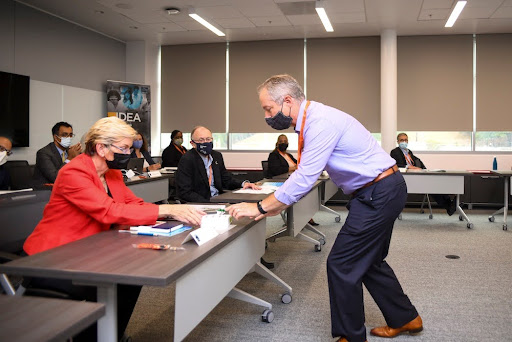
Jennifer Granholm (red jacket), Secretary of Energy, U.S. Department of Energy, and Congresswoman Barbara Lee (purple jacket) tour Berkeley Lab and talk with researchers and staff about how the lab supports the DOE mission including clean energy, climate science, and other science-based solutions to the problems facing the world today, at Lawrence Berkeley National Laboratory, Berkeley, California, 08/20/2021. Peter Fiske (purple shirt), Director, Natioinal Allilance for Water Innovation, and Director, Water-Energy Resiliance Institute, makes a presentation to the group on sustainable water.

Filed Under: Post

Published in PNAS, September 14, 2021. Access the publication. 

Researchers lack the tools for quantitatively evaluating the impact of their research on technology costs, especially when those technologies comprise multiple components or when the component costs are highly uncertain. We propose a suite of tools to aid in evaluating technology platforms, setting system- and component-level research targets and identifying high-impact innovation trajectories. These tools are applicable to any technology composed of multiple components whose performance or cost will benefit from innovation, but they are especially valuable for membrane systems in which the high interdependence in components amplifies or dampens the effects of innovation in nonintuitive ways.

Filed Under: Research Highlight

Lead author Jason Yang from NAWI Consortium Member Yale University discusses the results of molecular dynamics simulations examining the removal of small organic contaminants in water with nanoporous graphene membranes. Read about this research.

Filed Under: Research Highlight

  • « Go to Previous Page
  • Page 1
  • Page 2
  • Page 3
  • Page 4

Primary Sidebar

National Alliance for Water Innovation (NAWI)

Footer

  • About
  • Who We Are
  • Our Team
  • Our Partners
  • Contact Us
  • Join Us
  • Consortium Documents
  • NAWI Network FAQs
  • Research & Projects
  • Projects
  • Process Innovation and Intensification
  • Materials and Manufacturing
  • Data Modeling and Analysis
  • Devices
  • Regional Water Systems
  • Treatment Trains
  • Funding
  • Opportunities
  • Resources
  • Acknowledgments, Credit Lines, and Disclaimers
  • Funding FAQs
  • Publications & Data
  • Academic Publications
  • Roadmap Report Series
  • WaterTAP | Tool
  • Water DAMS | Data
  • Acknowledgments, Credit Lines, and Disclaimers
  • News & Stories
  • News
  • Blogs and Stories
  • Multimedia
  • Media

Join Us on Social Media

Privacy & Security Notice
National Alliance for Water Innovation (NAWI) is an Energy-Water Desalination Hub funded by the U.S. Department of Energy, Energy Efficiency and Renewable Energy Office, Industrial Technologies Office under Funding Opportunity Announcement DE-FOA-0001905
 Twitter

Share on Mastodon